
Large dumplings with a braided seam.
Kalmykia · first recorded 1893
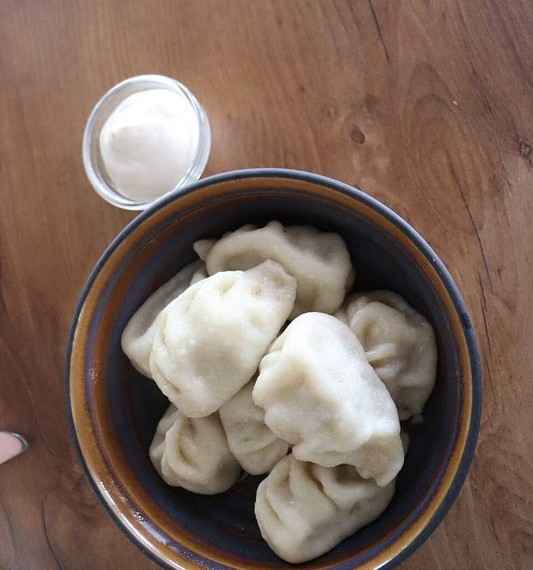 Photo Nakonana · CC BY-SA 4.0 · Wikimedia Commons
- Wrapper
- Wheat doughLarge dumplings with a braided top seam
- Filling
- Chopped mutton or beef, onion, fat
- Cooked
- Boiled
- Size
- About 6.5 cm acrossAn 8 cm round closed with a plaited seam into a crescent is about 0.8 times as long: about 6.5 cm.
Tastes of
- mutton or beef
- onion
- butter
Field notes
Story
Large Kalmyk dumplings closed with a braided top seam, filled with chopped mutton or beef, onion and fat, and boiled.
- How to eat it
- With butter, by hand.
Make it
Kalmyk börg (beriki) with lamb, beef and tail fat
- Makes
- about 40 dumplings
- Prep
- 60 min
- Cook
- 10 min
- Level
- medium
- Fold
- crescent pleat
How to fold: Crescent pleat

1 Filling in the middle of the round

2 Fold in half and pinch the centre shut

3 Make small pleats on the front edge only
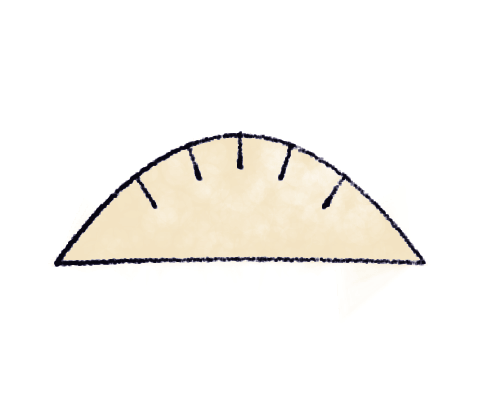
4 The pleats curve it into a crescent
Placeholder diagram. The atlas's illustrated fold animations will replace it.
Ingredients for 5
Dough
Filling
To cook
To serve
Method
- Mix the flour and salt, add the egg and water and knead to a smooth, fairly firm dough.
- Cover the dough and leave it to rest while you make the filling.Timer 20 min
- Cut the lamb, beef, tail fat and onions into pieces and pass them through a mincer fitted with the coarse plate.
- Season with the salt and pepper and work the mixture by hand until it turns sticky.
- Roll out the dough in portions and cut rounds about 8 cm across.
- Put a spoonful of filling in the middle of each round.
- Fold one end of the round over the filling and pinch it shut, then pinch the left and right edges over each other in turn so the seam runs along the top like a plait.
- Twist the last tip tightly to close it and set the dumpling on a floured board.
- Bring a large pot of salted water to the boil with the bay leaf and peppercorns.
- Lower the dumplings in and stir at once so they do not stick to the bottom.
- Once they float, simmer until the dough is tender and the meat cooked through.Timer 6 min
- Lift out with a slotted spoon, put the butter on top and serve hot.
Sources
- Бёрики (калмыцкие пельмени), Нина Минина-Р (iamcook.ru)
- Бёриги, бёрики, бёреки, бёрги - калмыцкие пельмени, Nina Minina (LiveJournal)
- Калмыцкая кухня (Мясные блюда), Калмыкия-online.ру
Where
From Kalmykia.
Evidence
Strong evidence
The ethnographer I. A. Zhitetsky, recording Kalmyk life near Astrakhan in 1884 to 1886, lists "beryk", vareniki with meat, among dishes made from meat. His book appeared in 1893. He adds frankly that such dishes were rare in the steppe and that he had only heard of them. A Kalmyk-Russian dictionary of 1977 gives meat dumplings as the word's first meaning.
Sources
- 1893Earliest record

The list of Kalmyk foods two pages earlier names «берык» among the dishes "изъ мяса" (beside «борцо», «чикисын махан»); p. 16: "е) «Чикисын махан» - колбасы изъ говядины, бараньяго и конскаго мяса. ж) «Берык» - вареники съ мясомъ и з) «хурын махан»…
- 1977

Footnote: "Это слово в калмыцком языке обычно пишется бөрг (в Калмыцко-русском словаре даны два основных его значения: I. 1) мясные пельмени, 2) вареники; II. карп [КРС 1977. 115]). Но этимология его явно связана со словом бөөрг, обозначающим почку…
The tagline and story are editorial; the facts trace to the research above. How we weigh evidence
Relatives