Buuz
буузbuuzsay booz
Thousands folded for the Lunar New Year.

- Region
- Mongolia and Buryatia
- First record
- 1935 · Modern & global
- Fold
- Purse, top-knot
- Cooked
- Steamed
Anatomy
Inside
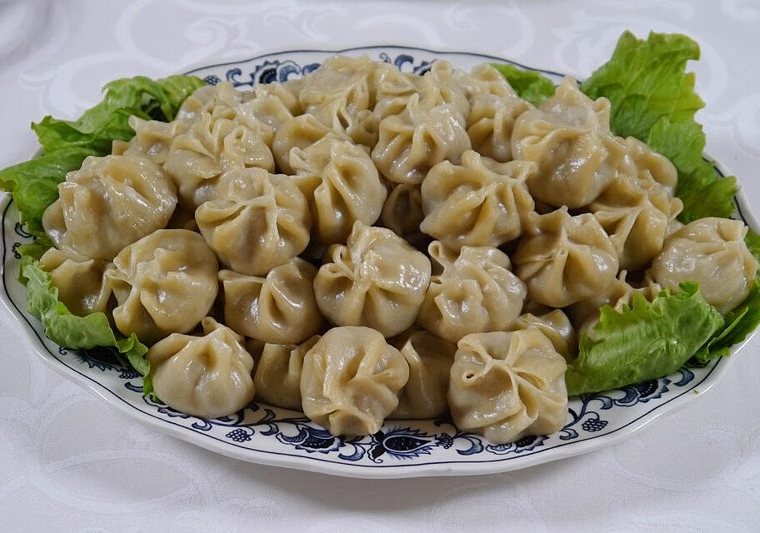
- Wrapper
- Wheat doughPurse, open top
- Filling
- Mutton/beef, onion, garlic
- Cooked
- Steamed
- Size
- About 6 cm across
Tastes of
- mutton
- onion
- garlic
- fat
Texture
- thick dough
- rich juice
Field notes
Story
Mongolian open-topped steamed dumpling of mutton and onion, related to Chinese baozi. Families make them by the thousand for Tsagaan Sar.
- How to eat it
- Bite a small hole, sip the hot juice, then eat.
- When
- Tsagaan Sar (Lunar New Year).
Did you know Buryat "pozy" and Tuvan "buuza" are the same dumpling a little further north.
Range
Where
From Mongolia.
Pin · Mongolia (Ulaanbaatar) · country, not a town
- OriginMongolia · Mongolia · country · Mongols
How sure we are
Evidence
Fairly sure. A dated text records it by 1935.
We list 5 sources: 3 primary or archaeological, 2 secondary. How grading works.
First record Burdukov, Russian-Mongolian colloquial dictionary, 1935, p. 194: "pirog, pirozhok: buuza", listed apart from pelmeni (D); first found, name only
Strongest sources
- A
Round 2. Primary, page images read (Russian-Mongolian, Mongolian in the Latin alphabet of the 1930s): p. 194 "пирог, пирожок buuza."; p. 188 "пельмени bianşi." So in spoken Khalkha of the early 1930s buuza was the word…
Round 2. Primary, page images read (Russian-Mongolian, Mongolian in the Latin alphabet of the 1930s): p. 194 "пирог, пирожок buuza."; p. 188 "пельмени bianşi." So in spoken Khalkha of the early 1930s buuza was the word for a filled pie or pasty and was kept apart from bansh (boiled dumplings), the same pair that Hangin's 1986 dictionary has. Title page: Leningrad Oriental Institute, 1935, with a preface and grammar sketch by N. N. Poppe. Identity match: strong on the name, partial on the preparation (no mention of steaming or of the filling). - A
Монголия и монголы, т. 1: Дневник и маршрут 1892 года
RELATED, DISH NOT NAMED: until 1878 ready food at the Urga (Khuree) market was sold only in the open by Chinese soldiers, who cooked and sold 'roast mutton, pirozhki with meat (пирожки съ мясомъ), pryazhentsy and…
RELATED, DISH NOT NAMED: until 1878 ready food at the Urga (Khuree) market was sold only in the open by Chinese soldiers, who cooked and sold 'roast mutton, pirozhki with meat (пирожки съ мясомъ), pryazhentsy and pryaniki'; groups of steppe Mongols sat on the ground around each brazier eating the hot pirozhki. In 1892-93 Pozdneev's own party carried frozen pel'meni from Urga. - A
A Modern Mongolian-English Dictionary
Entry: 'БУУЗ a kind of steamed meat dumpling' (also 'БАНШ meat dumpling').
Show all 5 sources
- S
Etymology only: buuz from Chinese baozi (包子); eaten at Tsagaan Sar. No dated history.
- S
Russian food-media articles on Buryat buuzy (search-result summaries)
Popular Russian articles say Buryat buuzy/pozy 'appeared about 400 years ago' (no source).
Found by research in October 2026; awaiting editorial review.
Notes from the research
From Chinese baozi.
The tagline and story are editorial; facts trace to the atlas research. History sources are from the atlas and not yet independently checked.
Family B