




















1. The journey of the dumpling

    Dough wrapped round something good, cooked in steam or water. People invented it many times, then carried it along caravan roads, armies, ships and kitchens. Here is what the evidence says, and how sure it is.

    Scroll to travel · the line at the bottom is time

  2. 01 · Ancientc. 100 CE

    Before the dumpling

    People have boiled grain paste for a very long time, but no prehistoric dumpling has been securely identified. The claim that tamales are 7,000–10,000 years old predates domesticated maize and is unverified. The firm evidence is painted: the San Bartolo murals in Guatemala, around 100 CE, and the Calakmul market murals with tamale vendors.
    A Archaeological or primary sourceTamal
  3. 02 · Silk Road & Tang3rd–6th century

    “Shaped like a crescent moon”

    In China, mantou appears in Jin-dynasty records (266–420), when the word still meant a filled bun, and Zhou Chu's Fengtu ji, written before 297, describes glutinous millet wrapped in wild-rice leaves and boiled for the fifth day of the fifth month: zongzi. In the 6th century Yan Zhitui wrote that “the jiaozi, shaped like a crescent moon, is a common food in the world”. The story of Zhang Zhongjing curing frostbitten ears with dumplings is a legend.

  4. 03 · Silk Road & Tang499–640

    Dumplings in a desert tomb

    Luoyang → Samarkand

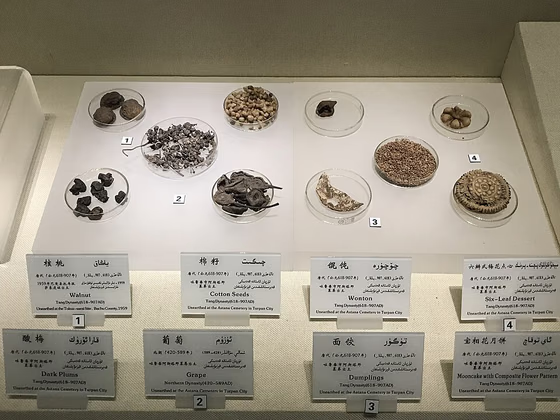
    A museum case of Tang-dynasty foods from the Astana Cemetery, including a dried wonton and a crescent dumpling, each on a glass dish with a label.
    Tang-dynasty wonton (3) and dumplings from the Astana Cemetery, Xinjiang Museum. Hiroooooo, CC BY-SA 4.0

    Follow the wheat west from the old capitals. The oldest dumplings you can actually hold come from the Astana Cemetery at Turpan, on the Silk Road: crescent dumplings and wontons, dried by the desert. A 2012 study dated one batch to 499–640 CE and found the dough was bread wheat mixed with foxtail millet. That the forms travelled further west along the road is inference, not evidence.

  5. 04 · Islamic & Mongol world1072–74

    A Turkic word for dough

    Around 1072, Mahmud al-Kashgari's dictionary of Turkic records tutmāč, a dough food, with a legend about Alexander's hungry soldiers attached. The word turns up again at the Mongol court in 1330 and in Ottoman kitchens in the 15th century. Wheat dough with garlic yoghurt is the thread that ties manti, joshpara and shish barak together.

  6. 05 · Islamic & Mongol worldc. 1180

    The dumpling eater of Hocheppan

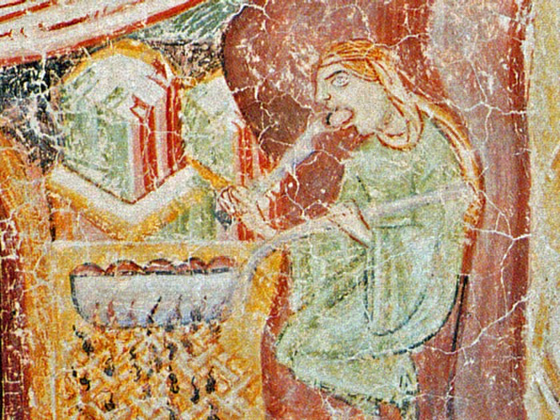
    Medieval fresco of a woman tasting a dumpling from a long spoon over a pot of round dumplings above a fire.
    The “Knödelesserin”, Hocheppan Castle chapel, c. 1180. Geisler Martin, CC BY-SA 3.0

    Europe's oldest dumpling picture is a fresco in the chapel of Hocheppan Castle near Bolzano, around 1180: a woman tastes a dumpling from a pot holding five more. Bread dumplings like canederli and Knödel are a European invention of their own, not a branch of the Silk Road family.

  7. 06 · Islamic & Mongol world1330

    The Khan's kitchen

    Kayseri → Kaesong

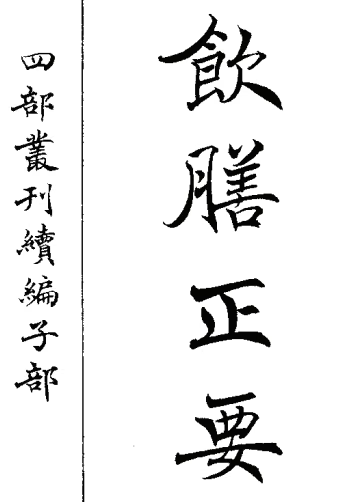
    Title page of the Yinshan zhengyao, Chinese characters printed in vertical columns.
    Title page of the Yinshan zhengyao (1330), from the 1456 edition. Unknown, Public domain

    Turkic and Mongol peoples carried the manti family across Eurasia, from Anatolia to the Korean court. Hu Sihui's Yinshan zhengyao, written for the Yuan court in 1330, records hand-pinched tutu mashi with garlic yoghurt and an “Uighur dish” of coin-shaped dough. Korean mandu is first recorded in the 14th century, in the Goryeosa, after Yuan contact.

  8. 07 · Islamic & Mongol world14th century

    Merchants and cooks write it down

    Ravioli appear in the 14th-century papers of Francesco Datini, a merchant of Prato. The Venetian Libro per cuoco simmers herb, egg and cheese ravioli in broth, and England's Forme of Cury (c. 1390) has rauioles: cheese in “a thin foile of dowe”, cast into boiling water.

  9. 08 · Renaissance & print15th century

    Steamed from noon till evening

    In the 15th century, Shirvani, physician to the Ottoman sultan Murad II, wrote down a mantı of ram, pounded chickpeas and cinnamon, steamed on stacked trays “from noon till evening” and served with garlic yoghurt and sumac. In Damascus, Ibn al-Mubarrad gives the earliest confirmed Arabic recipe for shushbarak, dough “rolled out like cut tutmaj”, boiled, then dressed with yoghurt, garlic and mint.

  10. 09 · Renaissance & print1520–1586

    Wheat crosses the Atlantic

    Santiago de Compostela → Mexico City · then Seville → Buenos Aires

    Spanish ships carried wheat, pork, lard and the empanada, printed in Barcelona's Llibre del Coch in 1520, to the Caribbean, Mexico and the Andes. They found the Americas already full of dumplings of their own: maize dough steamed in husks and leaves. A Lima dictionary of 1586 records the Quechua huminta. Iberian pork and names were folded into those parcels, not the other way round.

  11. 10 · Renaissance & printfrom 1652

    A supply station at the Cape

    Amsterdam → Cape Town

    In 1652 the Dutch East India Company founded a supply station at the Cape of Good Hope. Its settlers brought kluitjies, small flour dumplings, which became South Africa's souskluitjies, served in cinnamon syrup. The link rests on cooks' accounts rather than a dated text.

  12. 11 · Renaissance & print15th–17th century

    Printed in Polish and Swedish

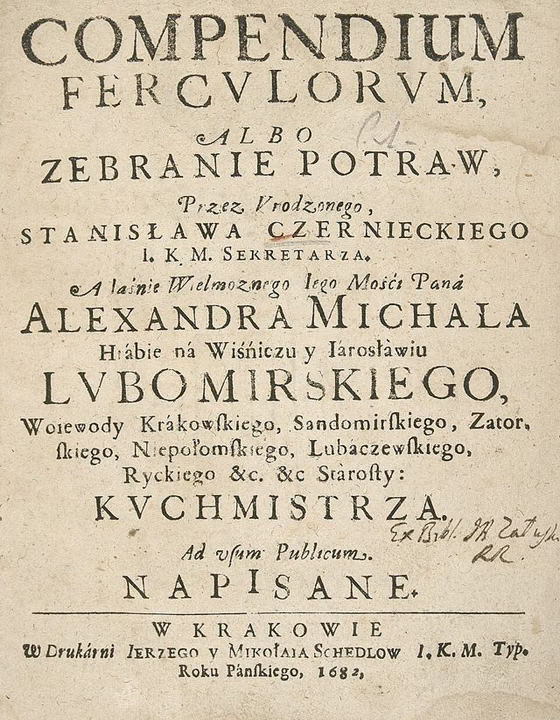
    Title page of Stanisław Czerniecki's Compendium Ferculorum, 1682, with ornate Baroque Polish typography.
    Czerniecki, Compendium Ferculorum (Kraków, 1682), the first cookbook in Polish. Unknown, Public domain

    Print fixes the recipes. Czerniecki's Compendium Ferculorum (1682), the first cookbook in Polish, has sweet pierogi and a veal-kidney one, with no potato yet. Sweden's palt is named in a 15th-century chronicle. The story of St Hyacinth and his pierogi in 1238 is a legend: his own biography never mentions them.

  13. 12 · Empires & migration1756

    Christmas in a plantain leaf

    In a 1756 Caracas court record, a woman says men came to buy the hallacas she made. By the 1850s they were the Christmas Eve dish of Caracas: maize dough wrapped round a stew with Iberian pork, olives and raisins, tied in plantain leaves. The popular story that slaves invented it from their masters' leftovers is a myth.

  14. 13 · Empires & migration1839–1879

    Suet and flour go west

    Plymouth → Asheville

    British settlers carried suet and flour dumplings and boiled puddings across the Atlantic, into the Caribbean and North America. In the American South they met chicken stew: Lettice Bryan's Kentucky Housewife (1839) layers chicken with rolled-paste “dumplings”, and a Virginia cookbook of 1879 gives chicken and dumplings as we know it. The transfer itself is secondary consensus; the recipes are dated.

  15. 14 · Empires & migration1725–1846

    The potato branch

    When the potato arrived from the Americas, Europe grew a whole new branch: gnocchi, Klöße, kopytka, cepelinai. Older batter dumplings were named too: a physician lists Swabian “Knöpflein” and “Spazen” in 1725. Matzo balls reach print in The Jewish Manual in 1846.

  16. 15 · Empires & migration1798–1855

    Ear bread and boiled pockets

    Pelmeni come from the Finno-Ugric peoples of the Urals: Udmurt and Komi pelnyan means “ear bread”. Which language gave Russian the word is contested; pelmeni barely appear in Russian print until Avdeeva describes frozen ones in 1837 and Radetsky prints a recipe in 1855. Further west, Kotliarevsky's Eneida (1798) already serves Ukrainian vareniki.

  17. 16 · Empires & migration1871–1893

    Soup in a pleated purse

    In Nanxiang, outside Shanghai, the soup-filled xiaolongbao is credited to Huang Mingxian around 1871, though a single inventor is restaurant lore; the craft is now on China's national heritage list. In 1893 Tilak turned Ganesh Chaturthi into a public festival in Maharashtra, and modak, offered to the god in twenty-ones, went with it.

  18. 17 · Empires & migration1880s–1914

    Kreplach to New York

    Vilnius → Pittsburgh

    From the 1880s to the First World War, Jews leaving the Russian Empire sailed from Hamburg and other ports to New York and on to the industrial cities. They carried kreplach, kneidlach and knishes, which became American deli food. Polish and Slovak workers brought pierogi to the same industrial towns.

  19. 18 · Empires & migration1880s–1920s

    Two Italian Americas

    Genoa → St Louis · then Genoa → Mar del Plata

    Italian emigrants left from Genoa and Naples in two great streams. In the United States, ravioli ended up breaded and fried in St Louis. In Buenos Aires they became sorrentinos, and gnocchi are still eaten on the 29th of every month, with a coin under the plate.

  20. 19 · Modern & globalc. 1880–1930

    Kibbeh in São Paulo

    Beirut → São Paulo

    Lebanese and Syrian emigrants sailed by way of Marseille to Brazil and Mexico. Kibbeh went with them, and became Brazilian quibe and Mexican kibi. In 1859 an American missionary in Sidon had already called it “the national dish of the Arabs”.

  21. 20 · Modern & global1928

    Across the Pacific

    Guangzhou → Lima

    Cantonese emigrants made new dumplings wherever they settled. Melbourne's dim sim is named by 1928; Honolulu has manapua, San Francisco the potsticker, and Lima's chifa kitchens fry their wonton. The route is secondary consensus; the dishes are local inventions.

  22. 21 · Modern & globalc. 1942

    Over the passes to Kathmandu

    Lhasa → Kathmandu

    Newar merchants based in Lhasa traded over the Kyirong and Kuti passes and brought Tibetan momo home to Kathmandu, adding buffalo and spices. A Kathmandu momo shop is first remembered around 1942; this is oral history. The story that Princess Bhrikuti carried momo to Tibet is a legend.

  23. 22 · Modern & globalafter 1945

    Gyoza comes home

    Shenyang → Utsunomiya

    Gyoza is recorded in Japan from 1689, but it became a mass food after 1945, when soldiers and settlers returning from Manchuria opened gyoza stands. Utsunomiya now calls itself the gyoza city; one of its best-known shops opened in 1958.

  24. 23 · Modern & globaltoday

    Not one family tree

    Dumplings were invented many times. Cameroon's fermented-cassava bobolo, Tahitian po'e, Haudenosaunee boiled cornbread and Mesoamerican tamales owe nothing to the Silk Road. The atlas tracks about ten families and is honest about which links are proven, which are probable, and which are only legend.

The end, for now

Keep exploring

Play the whole spread on the map · Every dated milestone ·How we grade the evidence