Bryndzové halušky
bryndzové haluškysay BRIN-dzo-veh HAH-loosh-kee
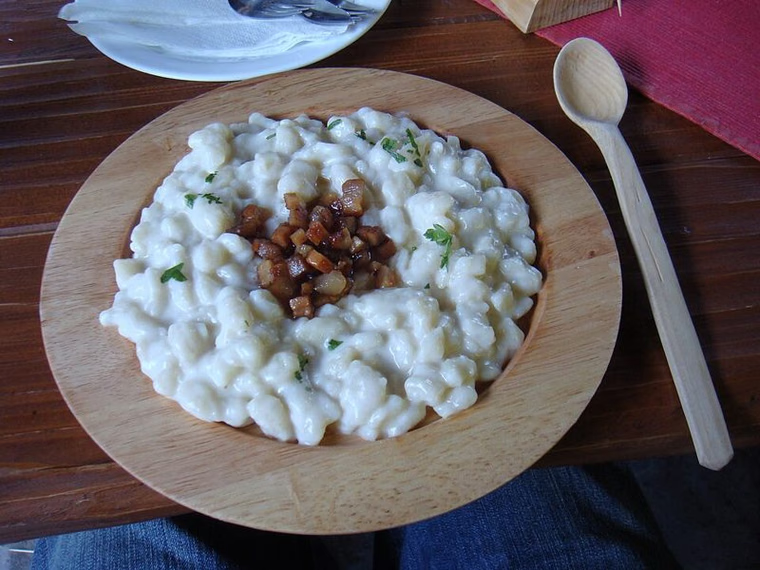
Potato nuggets under sheep's cheese and bacon.

- First record
- 1749 · Empires & migration
- Fold
- Heap of small pieces
- Cooked
- Boiled
Anatomy
Inside

- Dough
- Potato dough
- Made with
- Grated-potato flour gnocchi
- Cooked
- Boiled
- Size
- About 9 cm across
Tastes of
- sheep cheese
- bacon
- potato
Texture
- soft, sticky
Field notes
Story
Often called Slovakia's national dish: grated-potato dumplings tossed with tangy bryndza sheep cheese (an EU-protected cheese) and bacon. A German traveller already named it a Slovak speciality in 1749.
- How to eat it
- Eat hot, traditionally with a glass of žinčica (sheep whey).
- When
- Everyday; eating contests at Terchová.
Did you know The dish isn't protected, but its cheese is: Slovenská bryndza has been an EU PGI since 2008.
Range
Where
From Slovakia (national dish).
Pin · Liptov / northern Carpathian Slovakia (sheep-farming highlands; Liptov bryndza is the one praised in 1749); the dish spread across the mountain regions (Orava, Liptov, Spiš, Zvolen) · historical or cultural region, not a town
- OriginSlovakia · Upper Hungary · country · Slovaks
Protected name
None for the dish · Bryndzové halušky
Area: The ingredient is protected, not the dumpling. Slovenská bryndza is an EU PGI (16 Jul 2008); Bryndza Podhalańska is a PDO (Reg. (EC) 642/2007).
Do not label the dumpling as a GI.
How sure we are
Evidence
Fairly sure. A dated text records it by 1749.
We list 4 sources: 4 dated texts. How grading works.
First record Brückmann, Epistola itineraria (Wolfenbüttel 1749), names bryndzové halušky as a Slovak speciality, per Stoličná 2002 (D)
Sources
- D
SAV ethnologist reports that F. E. Brückmann, Epistola itineraria (Wolfenbüttel 1749), praising Liptov bryndza as 'Liptov theriac', names bryndzové halušky as a Slovak speciality. Earliest dated mention of the combination found.
- D
Stoličná 2002 (as above), citing Prekop 1970, Balko 1940
Bryndza (the cheese) is first recorded in a 1470 charter (Count V. Mölstein, settlement of Ladislav Valach, rent paid in sheep and bryndza); introduced by Wallachian colonisation (14th-17th c.); first bryndza works at…
Bryndza (the cheese) is first recorded in a 1470 charter (Count V. Mölstein, settlement of Ladislav Valach, rent paid in sheep and bryndza); introduced by Wallachian colonisation (14th-17th c.); first bryndza works at Detva, 1787 (Vagač family). This dates the cheese, not the dish. - D
Stoličná 2002 (as above), fn. 16
Ján Čaplovič (first ethnographic synthesis of the Slovaks, early 19th c.) describes halušky, likened to Nockerl or macaroni, eaten by Slovaks with tvaroh or bryndza and 'needing a good stomach'.
- D
Stoličná 2002 (as above), fn. 18, 19, 23, 24
Božena Němcová, 'Kraje a lesy ve Zvolensku' (first published 1859) lists 'halušky s bryndzou' among festive dishes and is the first to call them a 'national, Slavic dish'; A. Šustek, 'Bryndzové halušky a zvara',…
Božena Němcová, 'Kraje a lesy ve Zvolensku' (first published 1859) lists 'halušky s bryndzou' among festive dishes and is the first to call them a 'national, Slavic dish'; A. Šustek, 'Bryndzové halušky a zvara', Národnie noviny 10 Oct 1903 uses the full name; T. Vansová's cookbook (1914) calls bryndzové halušky 'the most popular national dish'. Ján Babilon's first Slovak-language cookbook (Pest 1870, c. 1500 recipes) has NO bryndzové halušky.
Found by research and reviewed, October 2026.
The tagline and story are editorial; facts trace to the atlas research. History sources are from the atlas and not yet independently checked.
Family E