
Alpine bread balls, first painted in 1180.
Trentino-South Tyrol · first recorded 1180
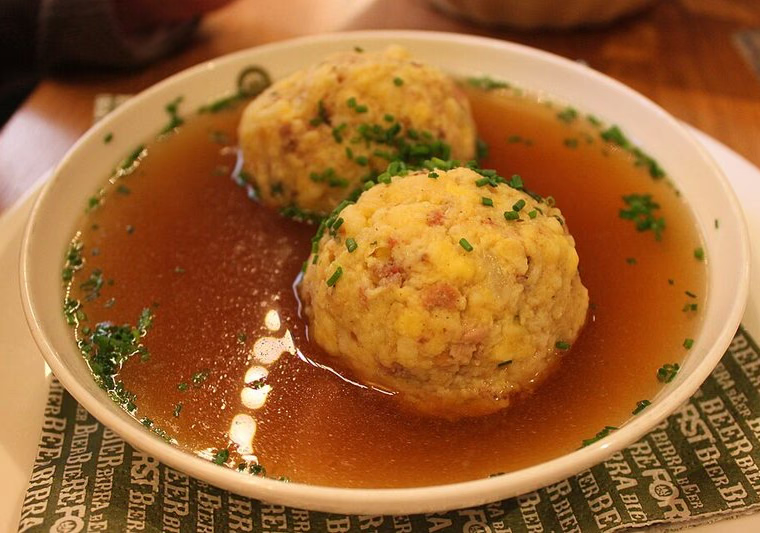
- Dough
- Bread doughStale bread, egg, milk
- Filling
- Speck, cheese, spinach
- Cooked
- Boiled, in soup
- Size
- About 6 cm acrossBalls given as 6 cm across; they swell little.
Tastes of
- speck
- bread
- chives
- broth
Texture
- dense, moist
Field notes
Story
Stale-bread dumplings bound with egg and milk and studded with speck. A fresco at Hocheppan Castle (c. 1180) shows a woman eating one.
- How to eat it
- In broth or with melted butter and cheese.
- When
- Everyday in the Alps.
Did you know The Hocheppan fresco is nicknamed the "Knödelesserin", the dumpling eater.
Make it
Speck canederli (Speckknödel) in broth
- Makes
- 8 dumplings
- Prep
- 30 min
- Cook
- 15 min
- Level
- easy
Ingredients for 4
Dumplings
To serve
Method
- Put the bread cubes in a large bowl.
- Soften the onion in the butter, add the speck and stir for a minute, then tip it over the bread.Timer 2 min
- Beat the eggs with most of the milk, the herbs, salt and pepper, and pour over the bread.
- Mix gently with your hands and leave to soak, covered. The bread should be moist but not mushy; add the remaining milk only if it is still dry.Timer 15 min
- Sprinkle in a little flour and mix; stop as soon as the mixture holds together when squeezed.
- With wet hands, press the mixture into 8 firm, smooth balls about 6 cm across.
- Bring a wide pot of salted water to the boil, then lower to a bare simmer. Test one dumpling first; if it falls apart, add a little more flour to the rest.
- Slide in the dumplings and poach without a rolling boil.Timer 15 min
- Lift them out with a slotted spoon and serve two per bowl in hot broth, scattered with chives.
Sources
- Canederli con lo speck (ricetta depositata, Accademia Italiana della Cucina 2003), Cucina Regionale Italiana
- Canederli allo speck, Genussland Südtirol (IDM Südtirol)
Where
From Trentino-South Tyrol.
- OriginSouth Tyrol · Tyrol · Tyroleans
Evidence
Strong evidence
The oldest evidence is a picture, not a text: a fresco at Hocheppan, painted around 1180, which makes canederli one of the earliest dumplings we can see with our own eyes. The popular story of an innkeeper improvising them for hungry mercenaries is legend.
Sources
- 15th c.

A South Tyrol farm-inn page says the words Knödel or Knötlein first appear in the 15th century for flour dumplings, and that the earliest recipe for 'Fastenknödel' (Lenten dumplings) is in a 15th-century Tyrolean cookbook, which it does not name.
Confirmed by web search; not yet read in full
- c. 1180–1210Earliest record

Burgkapelle St. Katharina (Hocheppan)
The 'Knödelesserin' (dumpling eater): a woman tasting a dumpling from a pot, in the Romanesque wall paintings of St Catherine's chapel at Hocheppan castle near Bolzano; the paintings were uncovered in 1926 and are dated between the late 12th century…
Confirmed by web search; not yet read in full
- 1180
Food writer: the Hocheppan fresco, dated 1180 and known locally as the 'Mangiatrice di canederli', is the oldest image of canederli.
Confirmed by web search; not yet read in full
- Undated

World Dumpling Atlas §6.17 (the legend as reported)
Legend: an innkeeper with nothing left in the larder improvised the first canederli from stale bread for hungry mercenaries (from the atlas; not traced to a source in this pass).
Not yet checked against the original
The tagline and story are editorial; the facts trace to the research above. How we weigh evidence
Family E


