Spätzle
say SHPETS-luh
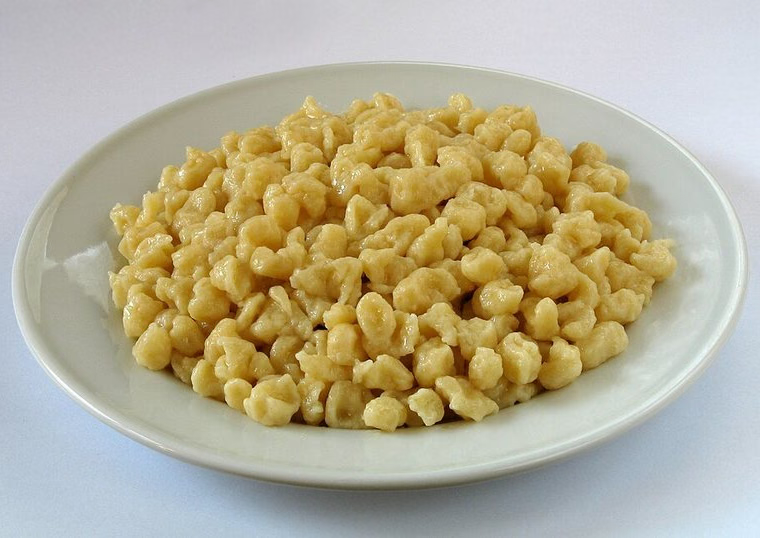
Squiggles of egg batter, scraped into boiling water.

- First record
- 1725 · Empires & migration
- Fold
- Heap of small pieces
- Cooked
- Boiled
- Dough
- Wheat doughEgg batter
- Made with
- Scraped or pressed
- Cooked
- Boiled
- Size
- About 6 cm across
Tastes of
- egg
- butter
- mountain cheese
- fried onions
Texture
- tender, irregular
Field notes
Story
Swabian egg-batter noodle-dumplings, first named in 1725, with the earliest recipe in 1783. EU PGI since 2012.
- How to eat it
- As Käsespätzle layered with cheese and crispy onions, or beside a roast.
- When
- Everyday.
History
1725: physician Rosinus Lentilius names "Knöpflein" and "Spazen". First recipe in the 1783 Göppinger Kochbuch (Rosina Dorothea Knör). Barbarossa-crusade stories are legend.
Did you know The name may mean "little sparrows".
Make it
Swabian Spätzle, scraped from the board
Ingredients for 4
Dough
To cook
To serve
Method
- Put the flour, eggs and salt in a deep bowl.
- Beat with a wooden spoon, adding water a little at a time, until the dough is thick, glossy and forms bubbles. It should drop slowly and heavily from the spoon. · timer 5 min
- Cover and let the dough rest. · timer 30 min
- Bring a large wide pot of water to the boil and salt it. Set a bowl of cold water beside it.
- Wet the Spätzle board in the hot water and spread about 2 tbsp of dough thinly at its front edge.
- Hold the board tilted over the pot and scrape thin strips of dough into the water with a wet knife or scraper, dipping the knife often.
- Once the noodles rise to the surface, let them boil a moment longer. · timer 1 min
- Lift them out with a slotted spoon, dip briefly in the cold water, drain and keep warm. Repeat with the rest of the dough.
- Toss the drained Spätzle in foaming butter just before serving. · timer 2 min
Notes. Scraping from a wet board (Spätzlebrett) is the traditional Swabian method and gives long, irregular noodles; a Spätzle press or a coarse grater/"Hobel" is the common shortcut and gives shorter, rounder "Knöpfle". The dough is mostly egg; Swabian cooks disagree on water: restaurant recipes (Vincent Klink) use only eggs, about 4 eggs per 200 g flour, while many household recipes use 5 eggs per 500 g flour plus water. Serve with gravy and roasts, with lentils and sausages (Linsen mit Spätzle), or layered with cheese and fried onions as Käsespätzle. Spätzle are described in Swabia by the physician Rosinus Lentilius in 1725; "Schwäbische Spätzle" have EU protected status (PGI) since 2012.
Written for the atlas from several sources, cross-checked: Schwäbische Spätzle, Vincent Klink / Restaurant Wielandshöhe (Stuttgart); Schwäbische Spätzle, Schwäbische Alb Tourismus. Not yet kitchen-tested.
Where
From Swabia, Alemannic area.
- Protected areaSwabia · Swabians
Protected name
EU PGI · Schwäbische Spätzle / Schwäbische Knöpfle
Reg. (EU) No 186/2012 of 7 Mar 2012 (OJ L 69, 8.3.2012), amended by Reg. (EU) 2017/333 · registered 2012-03-08
Protected area: All of Baden-Württemberg plus the Regierungsbezirk Schwaben in Bavaria
Evidence
Fairly sure. A dated text records it by 1725.
The grade comes from the project's source report and has not yet been checked source by source. How grading works.
This entry is drawn from the World Dumpling Atlas, §6.18, the project's source report. Its grade, D dated text, says how far that has been checked against a primary source.
The tagline and story are editorial; facts trace to the atlas research.
Family E