Cepelinai
cepelinaisay tseh-peh-LIN-eye
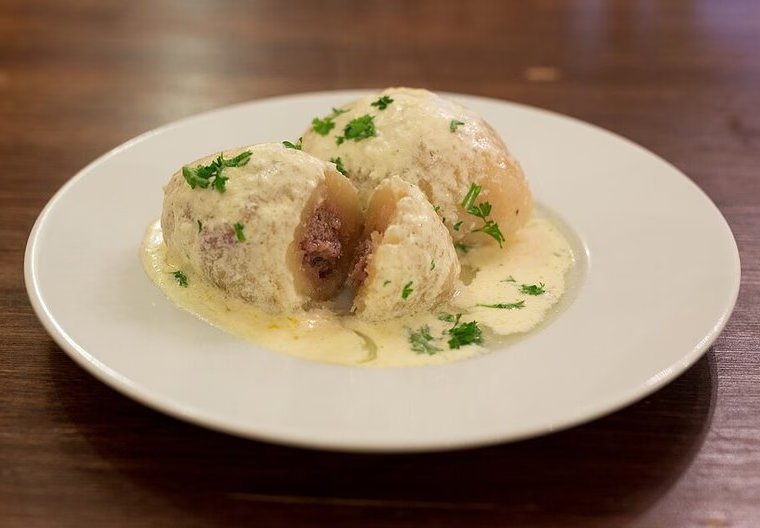
Potato airships stuffed with pork.

- Region
- Poland and the Baltics
- First record
- 1935 · Modern & global
- Fold
- Ball
- Cooked
- Boiled
- Wrapper
- Potato doughRaw-grated + cooked potato
- Filling
- Pork, curd, mushroom
- Cooked
- Boiled
- Size
- About 9 cm across
Tastes of
- potato
- pork
- spirgai (cracklings)
- sour cream
Texture
- dense, gummy, rich
Field notes
Story
Large zeppelin-shaped potato dumplings filled with pork or curd. First printed in 1935, and probably popularised after WWII in Soviet canteens.
- How to eat it
- Drown in sour cream and bacon cracklings.
- When
- Hearty everyday dish.
History
First printed recipes in the 1935 Ką valgome? (ed. Elena Repčytė-Starkienė). Ethnologist Vitalija Vasiliauskaitė (LRT 2023): probably from Prussia/Lower Saxony, popular only after WWII through Soviet canteens. The "renamed after the Zeppelin in 1900" date is unverified.
Did you know They are named after the Zeppelin airship because of their shape.
Make it
Cepelinai with pork filling and spirgučiai sauce
Ingredients for 4
Potato dough
Filling
Sauce
To cook
To serve
Method
- Mix the pork, onion, garlic, salt, pepper and cold water. Chill the filling while you make the dough.
- Finely grate the raw potatoes into a bowl, working fast. Stir in the vitamin C or a little lemon juice to slow greying.
- Squeeze the grated potato hard in a cloth or fine bag over a bowl, a handful at a time, until it is quite dry. Keep the liquid.
- Leave the squeezed liquid to stand so the starch settles at the bottom. · timer 10 min
- Pour off the liquid carefully and keep the white starch in the bowl.
- Peel and mash or finely grate the boiled potatoes.
- Combine the squeezed potato, the settled starch, the boiled potato and the salt. Knead until it is smooth and holds together; add potato starch only if it is too wet.
- Bring a large, wide pot of water to the boil and add the salt.
- With wet hands, take a portion of dough about the size of a large egg (roughly 150 g) and flatten it into an oval in your palm, about 1 cm thick.
- Put a walnut-sized piece of filling in the middle.
- Close the dough over the filling, press the seam well and smooth it into a pointed oval like an airship, with no cracks.
- Lower the dumplings one by one into the boiling water and stir gently so they don't stick to the bottom. Turn the heat down to a steady simmer.
- Simmer until cooked through, stirring now and then. · timer 25 min
- Meanwhile, fry the bacon in a pan until the fat runs and the pieces start to crisp. · timer 8 min
- Add the onions and fry until golden, then take the pan off the heat and stir in the sour cream. · timer 8 min
- Lift the cepelinai out with a slotted spoon, spoon over the sauce and scatter with dill.
Notes. Cepelinai (from Zeppelin) are Lithuania's national dish, also called didžkukuliai. They are a twentieth-century name for an older family of grated-potato dumplings. The ratio of raw to boiled potato varies by cook, from about 3:1 to 5:1; more boiled potato makes the dough easier to shape but less chewy. Cooking times in sources range from about 20 to 30 minutes depending on size. Other fillings are dry curd cheese (varškė) with egg and a little mint, or mushrooms. Diaspora cooks sometimes use a juicer or food processor instead of a hand grater. Reheat leftovers by slicing and frying them.
Written for the atlas from several sources, cross-checked: Cepelinų receptas, Balzekas Museum of Lithuanian Culture; Receptas. Cepelinai su mėsa, Virginija (TV3.lt); Lithuanian "Cepelinai" Potato & Meat Dumplings, Food52. Not yet kitchen-tested.
Where
From Lithuania. Popular in diaspora.
- OriginLithuania · Lithuanians
Evidence
Fairly sure. A dated text records it by 1935.
The grade comes from the project's source report and has not yet been checked source by source. How grading works.
This entry is drawn from the World Dumpling Atlas, §6.15, the project's source report. Its grade, D dated text, says how far that has been checked against a primary source.
The tagline and story are editorial; facts trace to the atlas research.
Family E