Germknödel
say GAIRM-kner-del
A ski-hut cloud of plum jam and poppy seed.

- First record
- 1890 · Empires & migration
- Fold
- Bun
- Cooked
- Steamed, boiled
- Wrapper
- Yeasted wheat doughYeast
- Filling
- Plum jam (Powidl)
- Cooked
- Steamed, boiled
- Size
- About 9 cm across
Tastes of
- plum jam
- poppy seed
- butter
- vanilla
Texture
- pillowy
Field notes
Story
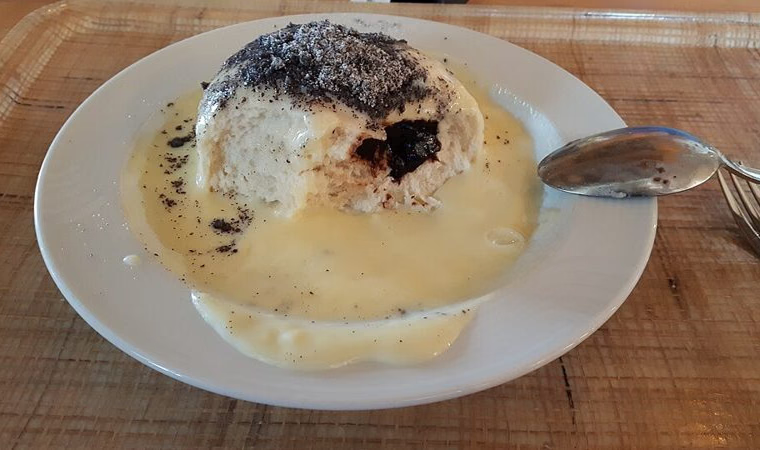
Fluffy Austrian yeast dumpling filled with Powidl plum jam, drenched in melted butter or vanilla sauce and topped with poppy-seed sugar. That is the modern form: 19th-century recipes boiled a plain yeast dumpling and served the Powidl alongside.
- How to eat it
- Break it open with a spoon so the jam meets the sauce.
- When
- Après-ski.
History
Prato's Die süddeutsche Küche (1890) boils a plain yeast dumpling and serves Powidl alongside (D). Filled forms appear around 1900.
Did you know "Germ" is Austrian German for yeast.
Where
From Austria.
- OriginTyrol/Austria · Tyrol · Austrians
Evidence
Fairly sure. A dated text records it by 1890.
We list 4 sources: 3 dated texts, 1 secondary. How grading works.
First record Katharina Prato, Die süddeutsche Küche (Graz), 'Gesottene Germ-Knödel' served with Powidl: read in the 1890 ed. (D); a blog dates the word to the 1879 ed. (not opened)
Sources
- D
Die süddeutsche Küche auf ihrem gegenwärtigen Standpunkte, 21. Auflage, p. 421
'Gesottene Germ-Knödel': fairly firm yeast dough (flour, yeast, yolks, lard, milk) shaped into large Knödel, risen again, boiled in salted water, torn open, buttered and served WITH Powidl or Zwetschkenpfeffer (not…
'Gesottene Germ-Knödel': fairly firm yeast dough (flour, yeast, yolks, lard, milk) shaped into large Knödel, risen again, boiled in salted water, torn open, buttered and served WITH Powidl or Zwetschkenpfeffer (not filled). Read in the 21st edition (Graz 1890; preface to 1st ed. dated Graz, August 1858). - D
Allgemeines österreichisches oder neuestes Wiener Kochbuch (Leeds University Library copy)
Ancestor in the oldest Austrian cookbook checked: Anna Hofbauer's Allgemeines österreichisches oder neuestes Wiener Kochbuch has 'Dampfnudeln' (no Germknödel).
- D
Die österreichische Küche, 6. Auflage, p. 357-358 (Germspeisen)
'Gekochte Germ-Knödel' (apple-sized yeast dumplings boiled in salted water, buttered, with Zwetschkenröster or Powidl, or topped with grated gingerbread or poppy seed; torn with a fork, never cut) and 'Böhmische, mit…
'Gekochte Germ-Knödel' (apple-sized yeast dumplings boiled in salted water, buttered, with Zwetschkenröster or Powidl, or topped with grated gingerbread or poppy seed; torn with a fork, never cut) and 'Böhmische, mit Mohn gefüllte Germknödel' (filled with poppy-seed filling, topped with poppy seed and sugar and brown butter). Read in the 6th edition 1910; 1st edition Innsbruck 1897. - S
Germknödel descends from the Dampfnudel (first mentioned 1698; first recipe 'aufgegangene Nudel' in the Neues Salzburgisches Kochbuch 1718); the word Germknödel first appears in Prato's 1879 edition ('gesottene…
Germknödel descends from the Dampfnudel (first mentioned 1698; first recipe 'aufgegangene Nudel' in the Neues Salzburgisches Kochbuch 1718); the word Germknödel first appears in Prato's 1879 edition ('gesottene Germknödel' with Powidl on the side); the first Powidl-FILLED Germknödel is a 'Mohnknödel' recipe in the Wiener Hausfrauenzeitung, 1897; Bohemian cookbooks long lack the dish, so the 'Bohemian origin' may be a later myth.
Found by research and reviewed, October 2026.
The tagline and story are editorial; facts trace to the atlas research.
Family E