Kibbeh
كبةkubba / kibbehsay KIB-beh
Bulgur shells around spiced lamb.

- Region
- Arab world and Levant
- First record
- 1774 · Empires & migration
- Fold
- Ball
- Cooked
- Fried, baked, simmered
Anatomy
Inside
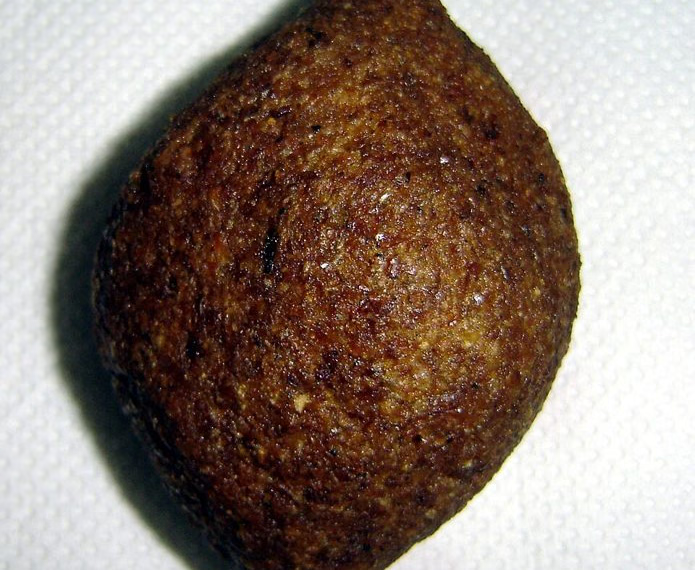

- Filling
- Spiced meat, pine nuts
- Cooked
- Fried, baked, simmered
- Size
- About 6 cm across
- Note
- A borderline case: it stretches the definition of a dumpling.
Tastes of
- lamb
- bulgur
- allspice
- pine nuts
Texture
- crisp shell (fried)
- tender filling
Field notes
Story
A shell of bulgur and meat around spiced lamb and pine nuts. Boiled in yoghurt, as kibbeh labaniyeh, it passes the dumpling test. Borderline shell type.
- How to eat it
- As mezze, or simmered in yoghurt sauce.
- When
- Mezze and family meals.
Did you know Lebanese and Syrian migrants took it to Brazil (quibe) and Mexico (kibi).
Range
Where
From Levant.
Pin · Central Levant (Bilad al-Sham: Lebanon/Syria); the earliest dated descriptions are Syrian-Levantine, Aleppo claim is fame not origin · historical or cultural region, not a town
- OriginLevant · Bilad al-Sham · historical or cultural region · Levantine Arabs
How sure we are
Evidence
Well established. An archaeological find or a primary source backs it.
We list 6 sources: 2 primary or archaeological, 2 dated texts, 2 secondary. How grading works.
First record Al-Zabidi, Taj al-'Arus (c. 1774) names the filled meat-and-grain kubba of al-Sham (D, Nasrallah 2013); Berggren 1844 describes boiled hollow koubbé in Syria (A)
Strongest sources
- A
Primary, opened: Berggren's French-Arabic phrasebook, article 'Cuisine', no. 19 'koubbé ... boulettes de viande creuses en dedans, mets favori des Arabes': coarse wheat (burghul) flour kneaded with minced meat into a…
Primary, opened: Berggren's French-Arabic phrasebook, article 'Cuisine', no. 19 'koubbé ... boulettes de viande creuses en dedans, mets favori des Arabes': coarse wheat (burghul) flour kneaded with minced meat into a very stiff paste, formed into balls filled with fat, pepper, salt; "le plus souvent cuites dans l'eau, et quelquefois frites ou grillées". Lists kinds: baked on a tray (bi-l-fourn), with chard and sour milk, with green broad beans, spinach, chickpeas, carrots, squash and pomegranate juice, grilled; quotes a folk verse "we would all be dead without kubbé". Collected in Syria (Berggren travelled there 1821-22). - A
The Land and the Book, vol. 1 (Harper, New York, 1859), pp. 134-135
Primary, opened: at Sidon a servant is "braying wheat with a pestle in a mortar, to make kibby, the national dish of the Arabs"; kibbet samak (fish kibbeh); usually mutton with sheep-tail fat, pounded, baked in a copper dish (vol. 1, pp. 134-135).
- D
Earliest mention of the modern filled shell of ground meat and grain is in al-Zabidi's dictionary Taj al-'Arus (compiled c. 1760-1774, Cairo), as made by the people of al-Sham; the 10th-c. Ibn Sayyar al-Warraq calls plain meatballs kubab (sing. kubba).
Show all 6 sources
- D
Pitts & Kabalan, in Making Levantine Cuisine (UT Press, 2021) — via Wikipedia 'Kibbeh'
1885 Beirut cookbook Ustadh al-Tabbakhin (Khalil Khattar Sarkis) gives 15 kibbeh recipes; al-Asadi's Aleppo encyclopedia (1971/1981) lists 58 kinds.
- S
Kibbeh and the question of origins
Charles Perry: no raw-meat preparation in the 10th- and 13th-c. Arabic cookbooks; minced meat mostly appears as meatballs; raw kibbeh spreads in the Ottoman 18th-19th c. Manal Mourad: Aleppo's kibbeh fame came via…
Charles Perry: no raw-meat preparation in the 10th- and 13th-c. Arabic cookbooks; minced meat mostly appears as meatballs; raw kibbeh spreads in the Ottoman 18th-19th c. Manal Mourad: Aleppo's kibbeh fame came via trade, "foods that passed through Aleppo were often credited to it". - S
من أرشيف المطبخ السوري.. قصة المتبل والكبة وحلاوة الجبن
Al-Baghdadi's Kitab al-Tabikh (7th c. AH / 1226) has pounded meat shaped into balls or discs, but the word kubba does not appear; Mesopotamian meat techniques do not prove a kibbeh-like dish.
Found by research and reviewed, October 2026.
Notes from the research
Shell type. National dish of Lebanon and Syria.
The tagline and story are editorial; facts trace to the atlas research. History sources are from the atlas and not yet independently checked.
Family I