
Drag to turn · tap to squish
Region
Iran, Kurdistan, Assyria, Arabia
First record
1787 · Empires & migration
Fold
Ball
Cooked
Boiled. Served in garlic-mint yoghurt soup (daw), in tomato and vegetable soup, or fried. Home food, rarely on restaurant menus
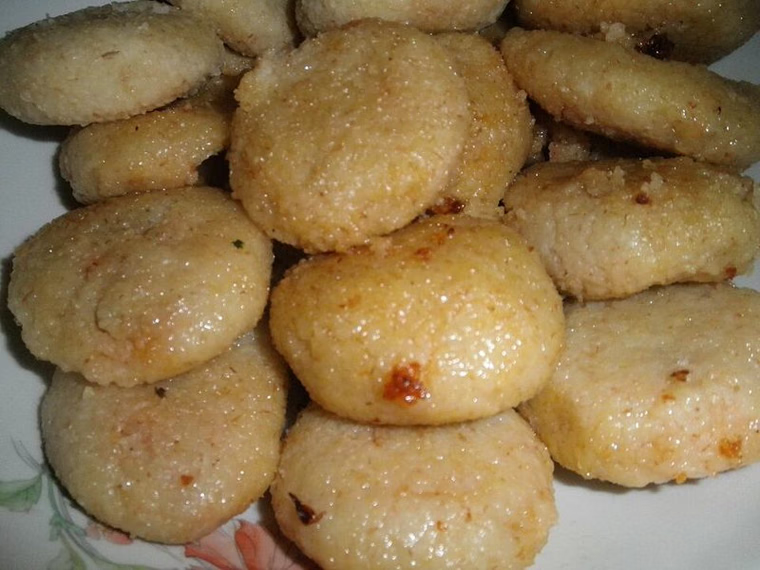
A plate of round Kurdish kutilk bulgur dumplings
As served. Photo Gomada, CC BY-SA 3.0, via Wikimedia Commons.
Dough
Shell; savory
Made with
Fine "köftelik" bulgur and semolina dough; spiced minced meat and onion
Cooked
Boiled. Served in garlic-mint yoghurt soup (daw), in tomato and vegetable soup, or fried. Home food, rarely on restaurant menus
Size
About 6 cm across
Note
A borderline case: it stretches the definition of a dumpling.

Not known yet We don’t yet have a written story, a recipe or a precise place of origin for Kurdish kutilk. What we do have is below, with its sources.

Where

Open the map →

From Kurdistan (Iraq, Turkey, Syria, Iran).

  • OriginKurdistan Region · Kurdistan · Kurds
Evidence

Fairly sure. A dated text records it by 1787.

We list 4 sources: 2 primary or archaeological, 2 secondary. How grading works.

First record Garzoni's Kurdish vocabulary (Rome, 1787, p. 216) prints 'Polpette - Kotélk' (A, page scan read); Chyet's Kurdish-English Dictionary (2003) lists Jaba & Justi's [kotelk] as a variant of kutilk, the stuffed patty (S for the identification).

Sources

  • A

    Grammatica e vocabolario della lingua kurda (Roma, Sacra Congregazione di Propaganda Fide, 1787), p. 216

    Archaeological or primary source · Maurizio Garzoni · 1787

    Primary, page scan read: Italian-Kurdish vocabulary, p. 216, "Polpette - Kotélk." The title page calls Garzoni a Dominican ("de' predicatori") and former apostolic missionary; that he worked at Amadiya (Bahdinan) and… Primary, page scan read: Italian-Kurdish vocabulary, p. 216, "Polpette - Kotélk." The title page calls Garzoni a Dominican ("de' predicatori") and former apostolic missionary; that he worked at Amadiya (Bahdinan) and that this is the first printed Kurdish grammar is general knowledge, not read here. The gloss is only "meatballs": no bulgur shell, filling or cooking method is described.
  • A

    Dictionnaire kurde-français (St.-Pétersbourg, Eggers, 1879), s.v. kotélk

    Archaeological or primary source · Auguste Jaba, ed. Ferdinand Justi · 1879

    Primary, OCR text read: "kotélk, boulette, G.; ar. [Arabic-script cognate, OCR illegible]". The abbreviation list of the same book gives "G. — Garzoni, Grammatica e vocabolario della lingua kurda. Roma 1787", so this entry repeats Garzoni and is not an independent 1879 witness.

  • S

    Kurdish-English Dictionary / Ferhenga Kurmancî-Inglîzî (Yale University Press, 2003), s.v. kutilk

    Secondary consensus · Michael L. Chyet · 2003

    Entry "kutilk / k'ut'ilk": "type of food made with danhêrk (type of wheat flour) consisting of patties stuffed with ground meat and minced onions"; variants "kutlik (IFb), kuttilk (GF), [kotelk] (JJ), <kutlik> (HH)";… Entry "kutilk / k'ut'ilk": "type of food made with danhêrk (type of wheat flour) consisting of patties stuffed with ground meat and minced onions"; variants "kutlik (IFb), kuttilk (GF), [kotelk] (JJ), <kutlik> (HH)"; "Cf. the pan-Middle Eastern kuftah (T köfte)". Sources keyed: JB1 = Joyce Blau, Le kurde de 'Amadiya et de Djabal Sindjar (1975); CB = Cemşid Bender, Kürt Mutfak Kültürü ve Kürt Yemekleri (Istanbul, 1992); JJ = Jaba & Justi 1879; HH = Yusuf Ziyaeddin Pasha, al-Hadiyya al-Hamidiyya (Beirut reprint 1975; the original edition date is not given in the key). This is the scholarly link between the 1787 word and today's stuffed dumpling.
  • S

    Kurmancî, bulletin of the Institut kurde de Paris, no. 14-15

    Secondary consensus · Institut kurde de Paris

    Trilingual glossary line "kutilk, kutlik, kuftik — içli köfte — boulette de gruau à la viande" (OCR snippet only; issue 14-15 of the journal, date not checked).

Notes from the research

Mostly recorded by community websites with an advocacy angle.

Family I

Kin