
Raw potato and barley around salt pork.
Norrbotten · first recorded 1642
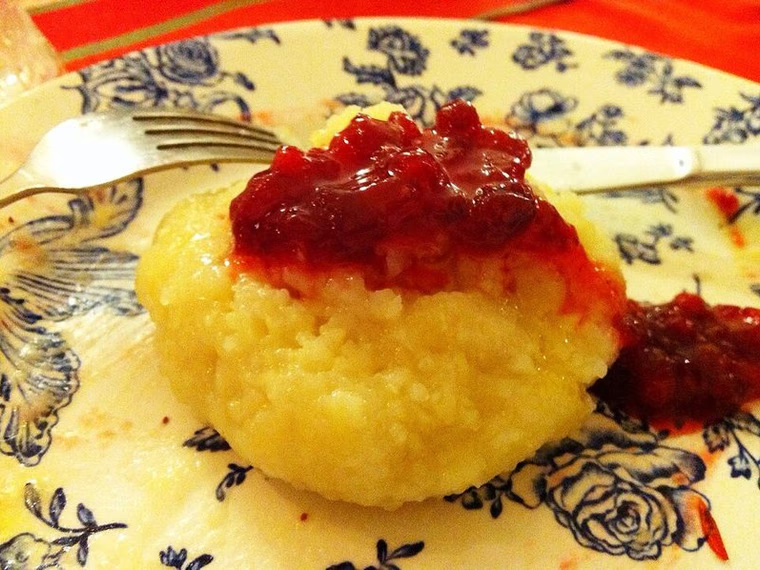 Photo Mrs. Gemstone on Flickr · CC BY-SA 2.0 · Wikimedia Commons
- Wrapper
- Potato doughRaw potato + barley flour
- Filling
- Salt pork
- Cooked
- Boiled
- Size
- LargeAn estimate, about 9 cm across: no source gives a measure yet.
Tastes of
- potato
- barley
- salt pork
- lingonberry
- butter
Field notes
Story
Dumpling of Norrbotten, named pitepalt for Piteå. Raw potato and barley flour are shaped round salt pork and boiled. The word "palt" is used for a boiled lump of dough in 1642; an earlier use, in a 15th-century chronicle, meant a cut of meat.
- How to eat it
- With lingonberry and butter.
History
Andreas Sparman (Palmcron) 1642 uses "palt" for a boiled dough lump, the earliest food sense (SAOB, Hellquist). An earlier "palt" in the 15th-c. Karlskrönikan chronicle meant a cut of meat, not the dish (Smaka Sverige).
Make it
Pitepalt with salt pork
- Makes
- 12 palt
- Prep
- 45 min
- Cook
- 50 min
- Level
- medium
Ingredients for 4
Dough
Filling
To cook
To serve
Method
- Bring a large pot of well-salted water to the boil.
- Optionally fry the diced pork for a few minutes until it starts to colour; set aside.Timer 5 min
- Finely grate the raw potatoes.
- Squeeze out most of the liquid with your hands or in a cloth.
- Mix the potato with the salt, barley flour and wheat flour into a soft dough that you can shape without it sticking. Work quickly so the potato does not darken.
- With floured hands, divide the dough into 12 balls.
- Press a deep hollow into each ball, add about 1 tbsp pork, and close the dough over it into a smooth ball.
- Lower the palt into the boiling water one by one as you shape them. Stir gently with a wooden spoon so none stick to the bottom.
- Simmer gently until they float and feel firm all through.Timer 45 min
- Lift out and serve hot with butter, lingonberries and a glass of cold milk.
Sources
- Guide till pitepalt: recept, historia och tips, Piteortens Chark (Piteå)
- Pitepalt, Arla Sverige
- Pitepalt, Land (Lantbrukarnas Riksförbund magazine)
Where
From Norrbotten (Piteå).
- OriginÖland (kroppkakor); Piteå SE-BD (palt) · Norrbotten (palt) · Swedes
Evidence
Good evidence
In 1642 Andreas Sparman used the word "palt" for a lump of boiled dough, the earliest food sense in the Swedish historical dictionaries. An earlier "palt" in the fifteenth-century rhymed chronicle Karlskrönikan meant a cut of meat, not the dish. This shows the name is old, but it doesn't describe the Piteå dish as it is made today.
Sources
- 15th c.

Karlskrönikan (as cited by the atlas, after Hellquist)
The atlas dates 'palt' to the 15th-century rhymed chronicle Karlskrönikan (after Hellquist's etymological dictionary). There the word meant a cut of meat, not the dish (Smaka Sverige, Jordbruksverket, read October 2026).
Not yet checked against the original
- 1642
Svenska Akademiens ordbok, s.v. palt
The Swedish Academy's dictionary (SAOB, entry 'palt') gives 1642 as the earliest food sense, Andreas Sparman's use of 'palt' for a lump of boiled dough (from the project's timeline notes; the SAOB entry was not reached in this pass). Smaka Sverige…
Not yet checked against the original
- 1642
Andreas Sparman (Schomerus; ennobled as Palmcron; 1609–1658), physician, published in 1642 his health manual Sundhetz Speghel, the book in which the word is reported; the passage itself was not seen.
Confirmed by web search; not yet read in full
- Undated
Reference summary: pitepalt, the potato-and-barley palt of Piteå in Norrbotten, filled with salt pork, where the dish is believed to have originated.
Confirmed by web search; not yet read in full
- Undated
Swedish food-heritage page on palt and kams, 'Historia': the first written record of the word palt is in the 15th-century Karlskrönikan, where it meant a cut of meat (en styckningsdetalj); palt in the sense of a boiled lump of dough is in…
The tagline and story are editorial; the facts trace to the research above. How we weigh evidence
Family E


