
A fermented steamed bun from the Himachal hills.
Mahasu · first recorded 1871
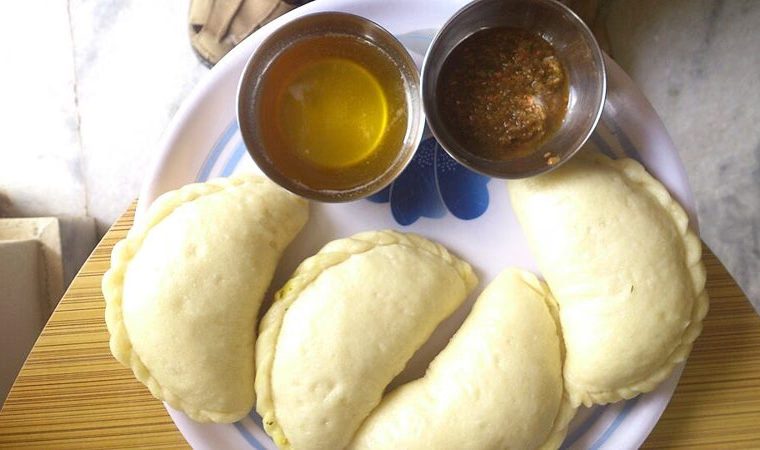 Photo Nilesh agnihotri · CC BY-SA 4.0 · Wikimedia Commons
- Wrapper
- Wheat or potato doughFilled bun; fermented wheat dough
- Filling
- Walnut, poppy seed (or "opium seed"), jaggery; or spiced lentil or potato
- Cooked
- Steamed
- Size
- LargeAn estimate, about 9 cm across: no source gives a measure yet.
- Note
- A borderline case: it stretches the definition of a dumpling.
Tastes of
- walnut
- poppy seed
- jaggery
- ghee
Field notes
Story
Himachali bun of fermented wheat dough, sweet with walnut, poppy seed and jaggery or savoury with spiced lentil or potato. It is part-cooked on the fire and then steamed. Historically it was food for travelling shepherds.
- How to eat it
- With ghee, chutneys, dal or mutton.
Did you know An 1871 account of Kullu lists "sidhoo" among the ordinary food of the landholders.
Make it
Siddu with spiced urad dal filling
- Makes
- about 6 siddu
- Prep
- 2.5 hours
- Cook
- 20 min
- Level
- medium
- Fold
- half moon
How to fold: Half-moon

1 Roll a thin round of dough

2 Spoon the filling into the middle
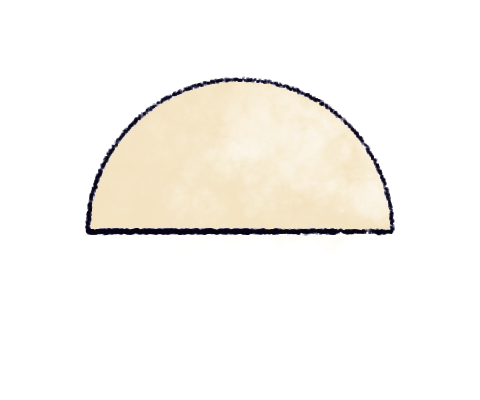
3 Fold it in half over the filling
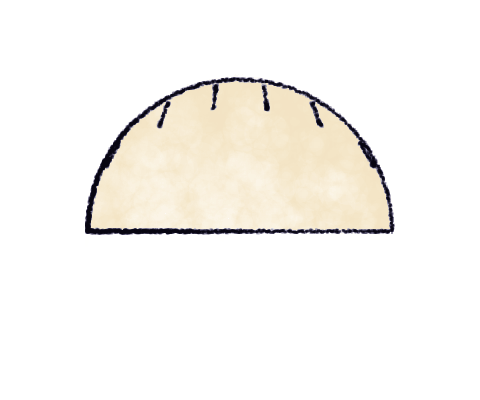
4 Press the edge firmly to seal it
Placeholder diagram. The atlas's illustrated fold animations will replace it.
Ingredients for 4
Dough
Filling
To serve
Method
- Rinse the urad dal and leave it to soak for about two hours.Wait 2 hours
- Mix the flour with the yeast, salt and ghee, add lukewarm water and knead to a soft dough.Timer 8 min
- Cover the dough and leave it somewhere warm to rise.Timer 90 min
- Drain the dal and grind it to a coarse paste with as little water as possible.
- Mix the paste with the ginger, green chillies, fresh coriander, turmeric, chilli powder, ground coriander, asafoetida and salt.
- Divide the risen dough into about six balls and roll each into a fairly thick round.
- Spread a spoonful of filling over one half of each round, fold the other half over and press the edge firmly shut.
- Bring water to the boil under a steamer and grease the tray. Set the siddu on it with space between them.
- Steam until the dough is cooked through and no longer sticky.Timer 18 min
- Brush the hot siddu with ghee.
- Cut each one into pieces and serve with more ghee and green chutney.
Sources
- How to make Siddu Recipe, Slurrp
- SIDDU or SIDDUKU – the Heart Winning Dish of DevBhoomi, Hill Post
- Siddu (bread), Wikipedia contributors
Where
From Mahasu (old Shimla district). Popular in Kullu, Mandi, all of Himachal.
Pin · Mahasu (old Shimla district)
- OriginKullu · Pahari
Evidence
Good evidence
In 1871 Captain Harcourt, writing on the Kullu valley, named "sidhoo" among the everyday foods of landholders, made from barley or maize flour "worked into thin cakes". An 1883 to 1884 gazetteer repeats him. The name and place match, but neither describes the steamed, stuffed bread made today. The suggested origin of the name in a Tibetan word for steamed bread is unproven.
Sources
- 1871Earliest record

The Himalayan Districts of Kooloo, Lahoul, and Spiti (London, W. H. Allen & Co., 1871), p. 267
Round 2. Primary, OCR text read (p. 267; page image not viewed): "In Kooloo the people eat three times a day... Those who are better off eat both the best descriptions of rice and flour; but the more general food of the Zemindars is made up of…
- 1883
Round 2. Official restatement, OCR text read (ch. III, The People, p. 24): "the more general food is barley, maize, amaranth, the poorer kinds of rice and vegetables. Sidhu is the name given to cakes made of barley or maize flour. Phimra is mixture…
- 1897
Gazetteer of the Kangra District, Parts II to IV: Kulu, Lahul and Spiti, 1897
FALSE FRIEND, do not use: in Kulu 'the bhat boiled with water and curds is called sidhu' - a rice/millet-and-curd porridge, not a bread. The same passage says pease-meal of mash or kulth 'is kneaded into balls, which are cooked by being steamed over…
- 1910
Punjab States Gazetteer vol. VIII: Simla Hill States, 1910
Simla Hill States (Bashahr): kulath is soaked, pounded, 'then made into round balls and steamed'. No siddu/sidu named anywhere in the OCR text.
- 1911
CANDIDATE, IDENTIFICATION UNCONFIRMED: 'Síḍ, n.f. A kind of bread; -o. pl.' (p. 235; read on the page image). No description of steaming, leavening or stuffing. The dictionary covers the Simla Hill States dialects, i.e. siddu's home area. Nobody in…
- 1911
A Dictionary of the Pahari Dialects as spoken in the Punjab Himalayas
RELATED DISH ONLY, same dictionary: 'Bauntsu, n.m. A kind of loaf made with fat, and cooked in steam (used in Balsan and Punar)' - shows steamed loaves were recorded in the Simla hills by 1911, under another name.
- Undated

Modern description only: fermented steamed stuffed wheat bread of Kullu, Mandi, Shimla, Rohru; no dated history.
Confirmed by web search; not yet read in full
The tagline and story are editorial; the facts trace to the research above. How we weigh evidence
Family independent


