
From Ga-Dangme, Ghana.
- Region
- Africa
- First record
- 1881 · Empires & migration
- Fold
- Mound, a swallow
- Cooked
- Boiled/stirred
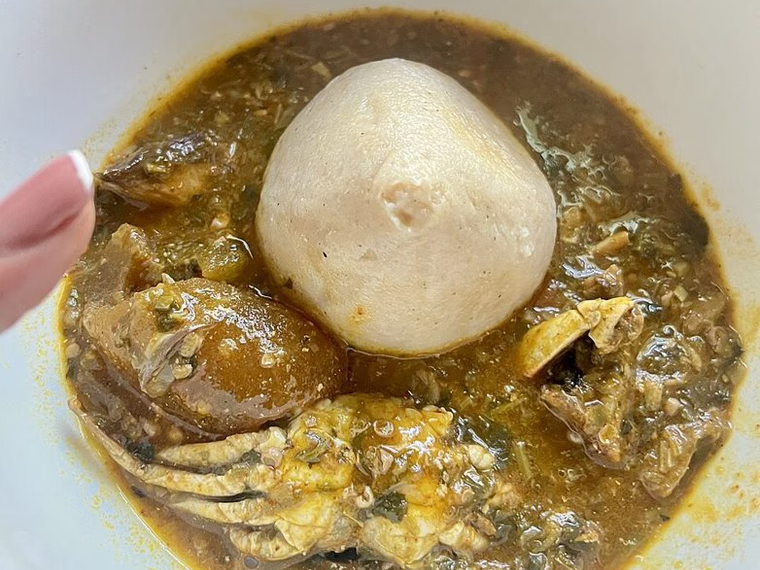
- Dough
- Fermented maize + cassava
- Made with
- Stirred, formed balls
- Cooked
- Boiled/stirred
- Served
- Okra stew, tilapia, pepper
- Size
- About 9 cm across
Not known yet We don’t yet have a written story, a recipe or a precise place of origin for Banku. What we do have is below, with its sources.
Where
Open the map →
Evidence
Fairly sure. A dated text records it by 1881.
We list 6 sources: 4 primary or archaeological, 2 secondary. How grading works.
First record Christaller, Dictionary of the Asante and Fante Language, 1881: "banku" listed among dishes prepared of maize (D); first found, name only, the fermented maize and cassava dough is not described
Strongest sources
- A
Under the maize word: 'aburoduan, food or dishes prepared of maize: [o]banku, abete, dokono, kyekyere, ammoagyanewa, mpampa, pimpi, sense, oto.' (Raw OCR: 'aburoduaiV, food ov dishes in-epuviid uf maize: ybanku, abete,…
Under the maize word: 'aburoduan, food or dishes prepared of maize: [o]banku, abete, dokono, kyekyere, ammoagyanewa, mpampa, pimpi, sense, oto.' (Raw OCR: 'aburoduaiV, food ov dishes in-epuviid uf maize: ybanku, abete, dokono, kyekyere, ammoagyanewa, inpampa, pimpi, sense, oto'. The noun prefix before 'banku' is one letter the OCR renders as 'y', presumably Christaller's open o; diacritics are not reproduced.) Banku is thus listed, next to dokono (kenkey), as a maize dish; no separate headword or recipe for it was found in the OCR text. - A
'banku, n. a kind of pap, made of wheat (nma).' The same vocabulary defines the grain: 'nma ... a kind of wheat, very small and black' (a millet; 'gbe nma, to thrash country-wheat').
- A
Related dish under its Ewe name, NOT the word banku: 'akplé, akpl[e] gekochte Klöße aus Maismehl, Reis oder Hirse (bli-, molt-, tokple [so the OCR]); sie bilden neben abolo und fufu das wichtigste Nahrungsmittel. da…
Related dish under its Ewe name, NOT the word banku: 'akplé, akpl[e] gekochte Klöße aus Maismehl, Reis oder Hirse (bli-, molt-, tokple [so the OCR]); sie bilden neben abolo und fufu das wichtigste Nahrungsmittel. da oder gbi a., diese Klöße kochen, bereiten ...' (boiled dumplings of maize, rice or millet flour; with abolo and fufu the most important food), with 'akplédati', the stick used to stir the akple while it cooks, and 'akplédaze', a pot for cooking the maize dumplings. The German-Ewe volume (1906) has 'Kloß ... akple' and 'Maisbrei ... akple'. (OCR garbles the special letters.)
Show all 6 sources
- A
Die Ewe-Stämme: Material zur Kunde des Ewe-Volkes in Deutsch-Togo (Berlin: Dietrich Reimer, 1906)
Spieth on the Ewe of German Togo: 'Auch fester Maisbrei, akple, mit Spinat und Palmöl wird gerne gegessen'; maize soaked in water is crushed into dough ('amowo') and 'Man kocht akple davon'; footnote: 'akple ist ein…
Spieth on the Ewe of German Togo: 'Auch fester Maisbrei, akple, mit Spinat und Palmöl wird gerne gegessen'; maize soaked in water is crushed into dough ('amowo') and 'Man kocht akple davon'; footnote: 'akple ist ein dicker, puddingähnlicher Maisbrei.' Soaked-maize dough stirred into a stiff pudding is the banku/akple technique, again under the Ewe name only. - S
Reported, not read: Pauline Whitby's 'Foods of Ghana' (Food Research Institute Research Bulletin, Accra, January 1968) is said to define banku (Ga) as 'a thick porridge made for home consumption or for sale in…
Reported, not read: Pauline Whitby's 'Foods of Ghana' (Food Research Institute Research Bulletin, Accra, January 1968) is said to define banku (Ga) as 'a thick porridge made for home consumption or for sale in chop-bars', from maize soaked for a day and dough fermented for two days. This comes from a web-search summary of the institute's PDF; the PDF itself could not be fetched (the server fails the TLS handshake), so the wording is unverified. - S
Banku (dish) (en.wikipedia) and food sites, search snippets
Banku is a Ga-Dangme dish of fermented maize and cassava dough; the name is said to come from Ga 'ba mi ku' ('ku in leaves'); other pages credit the Ewe (akple). No dates.
Notes from the research
Swallow ball.
Family H
Kin
More leaf-wrapped grain parcels (separate inventions)