Drag to turn · tap to squish
Region
Africa
First record
1602 · Renaissance & print
Fold
Leaf parcel or pillow
Cooked
Steamed

Anatomy

Inside

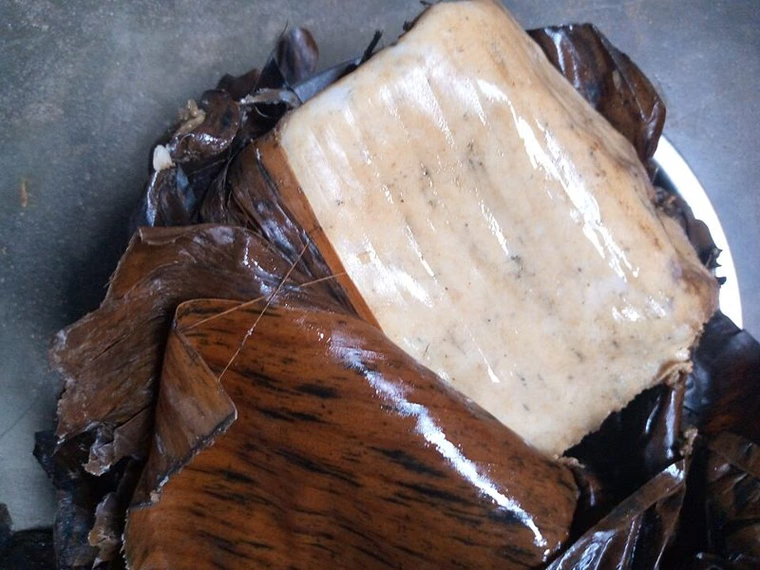
Fante kenkey unwrapped from plantain leaves
As served. Photo Azorbli, CC BY-SA 4.0, via Wikimedia Commons.
Dough
Maize dough
Made with
Plantain/banana-leaf wrap, softer, more sour
Cooked
Steamed
Size
About 9 cm across

Not known yet We don’t yet have a written story or a recipe for Kenkey: Fante dokono. What we do have is below, with its sources.

Range

Where

Open the map →

From Fante, Central Region (Yamoransa, Cape Coast).

Pin · Yamoransa, Central Region · city

How sure we are

Evidence

Well established. An archaeological find or a primary source backs it.

We list 5 sources: 3 primary or archaeological, 2 dated texts. How grading works.

First record de Marees 1602: maize bread "Kangues"/"Kanquies" sold at Elmina and Cape Coast (A); first found, baked rather than boiled

Strongest sources

  • A

    Beschryvinghe ende historische verhael van het Gout Koninckrijck van Gunea (1602), ed. S. P. L'Honoré Naber, Werken uitgegeven door de Linschoten-Vereeniging V ('s-Gravenhage, 1912), original col. 20a-20b and market plate legend

    Archaeological or primary source · Pieter de Marees; Internet Archive scan, OCR text read · 1602

    Bread-making on the Gold Coast: millet with 'een luttel Mays' is soaked overnight, ground on a stone to dough, mixed with water and salt, made into balls 'een paer vuysten groot' and laid on a warm floor 'daer het een… Bread-making on the Gold Coast: millet with 'een luttel Mays' is soaked overnight, ground on a stone to dough, mixed with water and salt, made into balls 'een paer vuysten groot' and laid on a warm floor 'daer het een luttel backt'. 'Die Negros vant Kasteel Damina [Elmina] backen schoon broot van Mays ...' and those who cannot make bread 'gaen te Merckt en coopen van dit broot, diese heeten Kangues'. In the legend to the plate of the market at Cabo Corsso: 'M. is de plaets daer die vrouwen vant Kasteel de Mina, met hun Kanquies te Merct comen sitten'. Elsewhere 'Kankiens, d'welck is hun broot'. The editor glosses kankiens as the balls of millet bread and notes 'kankie' still used for bread at Accra (Macdonald 1898, p. 204).
  • A

    A Voyage to Guinea, Brasil, and the West-Indies (London, 1735)

    Archaeological or primary source · John Atkins; Project Gutenberg ebook 72102 · 1735

    John Atkins (on the coast in 1721): 'what is a great part of their Food, Canky, the Work of the Women. It is made of Indian Corn ... they pound it in a Mortar ... malaxing it with Water and Palm-Wine, they grind it… John Atkins (on the coast in 1721): 'what is a great part of their Food, Canky, the Work of the Women. It is made of Indian Corn ... they pound it in a Mortar ... malaxing it with Water and Palm-Wine, they grind it still finer with a Mull upon a great Stone ...; baked or boiled in Cakes, it makes a hearty and well-tasted Bread.' At Cape Corso (Cape Coast) 'the Women keep a Market with their Canky, Papais, Soap and Fish'.
  • A

    A Dictionary of the Asante and Fante Language called Tshi (Chwee, Twi) (Basel, 1881)

    Archaeological or primary source · J. G. Christaller; Internet Archive scan (OCR is poor: the gloss reads 'boiled lucdd of maize') · 1881

    First found under the Akan name: 'ɔ-dɔkono, boiled [bread] of maize; cf. abodo', and 'kankyew (F.)' given as the Fante word for bread ('man's staff of life is bread').

Show all 5 sources

Found by research in October 2026; awaiting editorial review.

Notes from the research

Yamoransa production history (2024 Cogent Arts & Humanities article).

History sources are from the atlas and not yet independently checked.

Family H

Kin