Humitas
humitasay oo-MEE-tah
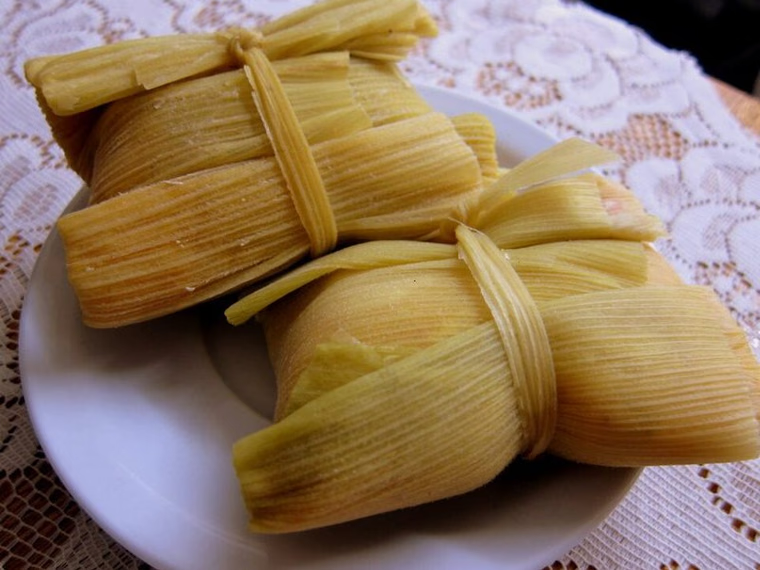
Fresh corn in its own husk.
DDated textFamily H · Leaf-wrapped grain parcels (separate inventions)

- Region
- South America and Andes
- First record
- 1586 · Renaissance & print
- Fold
- Leaf parcel or pillow
- Cooked
- Steamed, boiled
Anatomy
Inside

- Dough
- Maize dough
- Made with
- Fresh corn, cheese, corn husk
- Cooked
- Steamed, boiled
- Size
- About 9 cm across
Tastes of
- fresh corn
- cheese
- basil
Texture
- creamy
Field notes
Story
Andean fresh-corn parcels with cheese, onion or basil, wrapped in the corn's own husk ("en chala"). Borderline dumpling.
- How to eat it
- Unwrap and eat warm.
- When
- Summer harvest.
Did you know The name comes from Quechua humint'a.
Range
Where
From Andes (word and earliest texts Peruvian Quechua; Ecuador and Chile today).
Pin · Quechua-speaking central Andes (pin at Cuzco). The word and earliest records are Peruvian/Inca, and no single origin town is documented. · historical or cultural region, not a town
How sure we are
Evidence
Fairly sure. A dated text records it by 1586.
We list 3 sources: 3 dated texts. How grading works.
First record 'Bollo de mayz ... huminta' in the Arte y vocabulario printed by Antonio Ricardo in Lima, 1586 (D, opened)
Sources
- D
Spanish–Quechua section: 'Bollo de mayz. çara tanta, huminta' (OCR 'buminta'). A maize bun called huminta in the first printed Quechua vocabulary.
- D
Diccionario histórico de la lengua española (DHLE), 'humita'
Historical dictionary entry: from Quechua humint'a. The Quechua word huminta is registered from 1603 (Arte y vocabulario... Quichua, Seville reprint) as 'bollicos de mayz, que se cuezen en la olla'. Inca Garcilaso…
Historical dictionary entry: from Quechua humint'a. The Quechua word huminta is registered from 1603 (Arte y vocabulario... Quichua, Seville reprint) as 'bollicos de mayz, que se cuezen en la olla'. Inca Garcilaso explains the two maize breads zancu and huminta. The Spanish form 'humita' is first recorded in Terreros y Pando's Diccionario castellano (1787), 'in Peru, a small cake of sugar and tender maize wrapped in a delicate choclo leaf', then 1789 (J. F. Aguirre's diary, 'Vmita ... served in the plant's own leaves'), 1807 (uminta). Used in Ec., Pe., Bo., Ch., Ar., Ur. - D
Comentarios reales de los Incas (1609), as reported by RAE DHLE
Garcilaso de la Vega, Comentarios reales (Lisbon, 1609): maize breads zancu (sacrificial) and huminta (festive).
Found by research and reviewed, October 2026.
Notes from the research
Quechua huminta in the Lima Arte y vocabulario (1586) (D). Garcilaso 1609.
The tagline and story are editorial; facts trace to the atlas research. History sources are from the atlas and not yet independently checked.
Family H
Kin
More leaf-wrapped grain parcels (separate inventions)