
A sticky-rice cylinder in banana leaf.
Cambodia · first recorded 1902
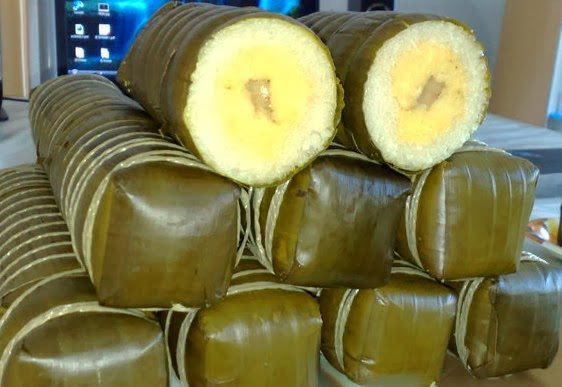 Photo វ៉ង់ វណ្ណលីដា · CC BY-SA 3.0 · Wikimedia Commons
- Dough
- Rice doughLeaf-wrapped cylinder
- Made with
- Glutinous rice; banana, jackfruit, or pork and mung bean
- Cooked
- Steamed
- Size
- LargeAn estimate, about 9 cm across: no source gives a measure yet.
- Note
- A borderline case: it stretches the definition of a dumpling.
Tastes of
- glutinous rice
- banana
- jackfruit
- pork and mung bean
Texture
- sticky
Field notes
Story
Cambodian cylinder of glutinous rice wrapped in banana leaf, filled with banana (chek), jackfruit (khnao) or pork and mung bean (chrouk). It is steamed, and may be grilled or fried afterwards.
- When
- Khmer New Year and Pchum Ben.
Did you know Guinness World Records lists a 4,040 kg num ansom, 5.2 m long, made in Siem Reap on 13 April 2015.
Make it
Num ansom chek (Cambodian banana sticky-rice rolls)
- Makes
- 6 rolls
- Prep
- 40 min
- Cook
- 60 min
- Level
- medium
- Fold
- leaf wrap
How to fold: Leaf wrap
1 Lay out a softened leaf or husk

2 Spread the dough or batter in the middle

3 Fold in the long sides, then the ends

4 Tie the parcel and steam or boil it
Placeholder diagram. The atlas's illustrated fold animations will replace it.
Ingredients for 6
Rice
Filling
Wrapping
Method
- Soak the rice in plenty of cold water for at least 6 hours or overnight.Wait 6 hours
- Drain the rice in a sieve until it is damp but no longer dripping.
- Mix the grated coconut through the rice.
- Peel the bananas, halve them and sprinkle them with the salt.
- Wipe the banana leaves clean and lay one down with a long side towards you.
- Spread a line of rice along the leaf, a little longer than a banana half.
- Lay a banana half on the rice and cover it with more rice so the fruit is enclosed on all sides.
- Roll the leaf tightly round the rice into a firm log, then fold both ends in to seal.
- Tie the roll with string in several places so it keeps its shape. Repeat with the remaining bananas.
- Line a steamer with spare leaf, stack in the rolls, cover and steam over boiling water until the rice is soft and translucent. Top up the water as needed.Timer 60 min
- Cool a little, then unwrap and slice. Eat warm or at room temperature.
Sources
- Num Ansom Chek (Rolled Banana Rice Cake), Ally (Amcarmen's Kitchen)
- Khmer Festive Sweet – Num Ansom Chek – Banana Filled Steamed Rice Cakes, Dosaikal
- Num Ansorm (Khmer Sticky Rice Cake), IntoCambodia.org
Where
From Cambodia.
Evidence
Strong evidence
Bernard's 1902 Cambodian-French dictionary describes it plainly: a rice roll wrapped in banana leaves and boiled. That's the earliest record we've found, and it shows the dish was already familiar, not when it began. A 1951 study of Khmer worship is often cited for the symbolism of these sticky rice cakes, but we haven't been able to read that passage.
Sources
- 1902Earliest record

Dictionnaire cambodgien-français (entries ÂNSÂM and NOM)
Entry: 'ÂNSÂM. Nôm —, pâté de riz qu'on roule dans des feuilles de bananier et qu'on fait cuire à l'eau.' Also listed as '— ânsâm' among the cakes under NOM.
- 1951

Notes sur les particularités du culte chez les Cambodgiens, BEFEO 44(2): 619-641
Wikipedia cites Porée-Maspero 1951, p. 633, for the linga/yoni symbolism of sticky rice cakes (num ansom and num kom). The Persée landing page was opened but shows only the article's opening pages; the passage itself was not read.
Not yet checked against the original
- 2015

Offered to ancestors at Pchum Ben and made for Khmer New Year; Guinness record for the largest num ansom, 13 April 2015.
The tagline and story are editorial; the facts trace to the research above. How we weigh evidence
Family H
Kin
More leaf-wrapped grain parcels (separate inventions)


