Zongzi
粽子zòngzisay DZONG-dzuh
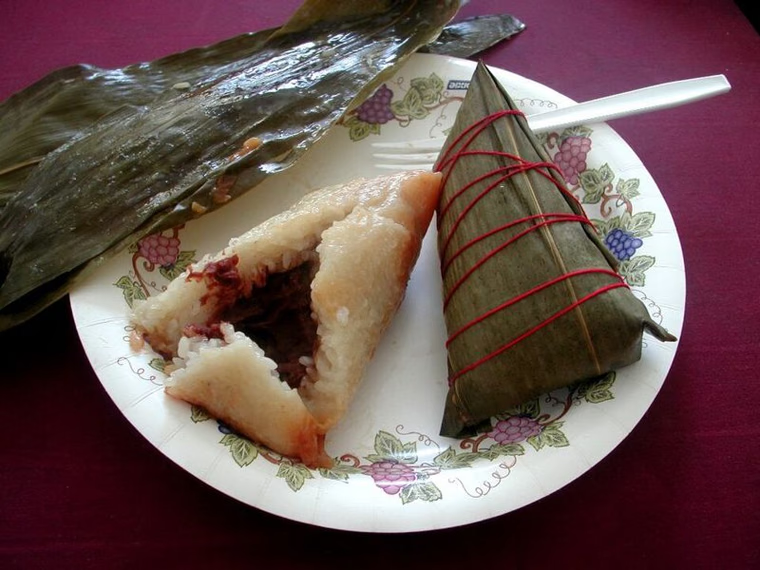
A pyramid of rice tied in bamboo leaves.
ADLArchaeological or primary source, with a legend attachedFamily H · Leaf-wrapped grain parcels (separate inventions)

- First record
- 290 CE · Silk Road & Tang
- Fold
- Pyramid, leaf-wrapped
- Cooked
- Boiled
- Dough
- Rice doughGlutinous rice in bamboo/reed leaves
- Filling
- Pork belly, yolk, red bean
- Cooked
- Boiled
- Size
- About 9 cm across
- Note
- A borderline case: it stretches the definition of a dumpling.
Tastes of
- glutinous rice
- pork belly
- salted egg yolk
- bamboo leaf aroma
Texture
- dense, sticky
Field notes
Story
Glutinous rice with pork belly, salted yolk or red bean, wrapped in bamboo or reed leaves and boiled. Borderline dumpling: the wrapper is a leaf.
- How to eat it
- Untie the string, unwrap the leaves, eat with chopsticks.
- When
- Dragon Boat Festival.
History
Zhou Chu's Fengtu ji (Western Jin, before 297) describes the custom (D). Zongzi excavated from a Northern Song tomb at Nanling, Anhui, buried by 1113 (A). The Shuowen gloss 蘆葉裹米也 is from Xu Xuan's 986 supplement, not the Han text. Leaf-wrapped, so borderline.
Did you know Legend says people threw rice into the river to protect the drowned poet Qu Yuan.
Where
From China-wide. Popular in East/SE Asia.
- OriginSouth China · Han
- Popular inJiaxing · Jiangnan · Han
Evidence
Well established. An archaeological find or a primary source backs it. Part of its origin story is legend.
We list 8 sources: 3 primary or archaeological, 2 dated texts, 2 secondary, 1 legend. How grading works.
First record Zhou Chu, Fengtu ji (Western Jin, before 297): leaf-wrapped glutinous millet boiled in lye, called zong / jiaoshu, eaten on 5/5 (D)
Strongest sources
- A
Leaf-wrapped grain bundles (Quercus dentata leaves around unhulled rice and broomcorn/foxtail millet, tied with grass cord) from Chu tombs: Chengyangcheng M8, Xinyang, Henan (c. 339–329 BCE) and Wuwangdun M1, Huainan,…
Leaf-wrapped grain bundles (Quercus dentata leaves around unhulled rice and broomcorn/foxtail millet, tied with grass cord) from Chu tombs: Chengyangcheng M8, Xinyang, Henan (c. 339–329 BCE) and Wuwangdun M1, Huainan, Anhui (King Kaolie of Chu, d. 238 BCE). The authors call them 'a possible precursor of zongzi'; unhulled grain means funerary offerings, not food. - A
Two pyramid-shaped leaf-wrapped zongzi from a Northern Song tomb at Tieguai, Nanling (Anhui), excavated 2014; occupant died by 1112, buried by 1113; CT scans suggest a meat filling. Oldest surviving zongzi objects.
- A
最古老的实物粽子长啥样?江西一南宋古墓出土 / search summary of Jiangxi museum reports
Two zongzi tied to a peach branch in the hand of Lady Zhou, Southern Song tomb at De'an, Jiangxi (found 1988); epitaph dates burial to Xianchun 10 = 1274.
Show all 8 sources
- D
糉 entry (quotes 風土記 via 太平御覽; notes the 說文 definition is in 說文新附)
Zhou Chu (236–297), Fengtu ji (Yangxian Fengtu ji), Western Jin: people wrap glutinous millet in wild-rice (菰) leaves, boil it in strong lye until soft and eat it on 5/5 and at the summer solstice; called 粽 (稯) or 角黍.…
Zhou Chu (236–297), Fengtu ji (Yangxian Fengtu ji), Western Jin: people wrap glutinous millet in wild-rice (菰) leaves, boil it in strong lye until soft and eat it on 5/5 and at the summer solstice; called 粽 (稯) or 角黍. Survives as quotations (Taiping yulan; also Qimin yaoshu, 544). - D
粽 (Chinese Wikipedia), used only as a pointer
Same Fengtu ji passage; texts predate the Qu Yuan association, which first appears in Wu Jun's Xu Qi Xie ji (early 6th c.).
- S
Chinese report of the same work: 40 bundles at Chengyang M8, 200+ at Wuwangdun; Wuwangdun bundles held animal-derived residue; team incl. Peng Huasheng and Huang Luqi (China Academy of Chinese Medical Sciences); researchers say proto-zongzi, not proven zongzi.
- S
Journalistic history: Fengtu ji names 角黍 for 端五; Shuowen gives '芦叶裹米也'.
- L
續齊諧記 (Wu Jun, Liang), as reported by zh.wikipedia and zdic
Qu Yuan origin (rice thrown into the Miluo to feed/protect the drowned poet, d. c. 278 BCE).
Found by research and reviewed, October 2026.
The tagline and story are editorial; facts trace to the atlas research.
Family H
Kin
More leaf-wrapped grain parcels (separate inventions)