
Pinched parcels of leftover roast.
Piedmont · first recorded 1791
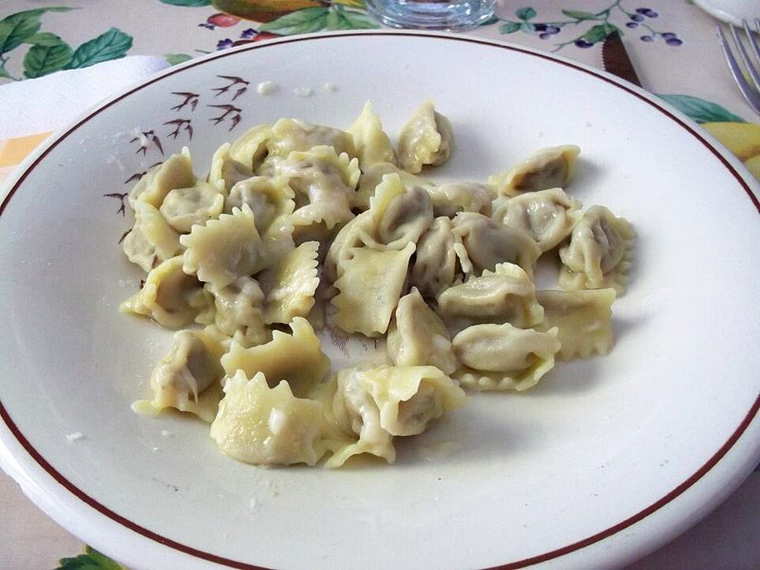 Photo Andrea Marchisio · CC BY-SA 3.0 · Wikimedia Commons
- Wrapper
- Wheat doughPinched
- Filling
- Roast meats, vegetables
- Cooked
- Boiled
- Size
- About 2.5 cm acrossHazelnut-sized fillings 1 cm apart, folded over and cut between, give pieces about 2.5 cm long.
Tastes of
- roast meat
- butter
- sage
- roast juices
Texture
- tiny, tender
Field notes
Story
Small Piedmontese pasta, pinched ("plin") around fillings of roast meat and vegetables.
- How to eat it
- With butter and sage, roast juices, or dry in a napkin ("nel tovagliolo").
- When
- Sunday and feast days.
Did you know "Plin" is Piedmontese for "pinch".
Make it
Agnolotti del plin (pinched Piedmontese agnolotti with roast meats)
- Makes
- about 120 small agnolotti
- Prep
- 2 hours
- Cook
- 105 min
- Level
- hard
- Fold
- square seal
How to fold: Half-moon

1 Roll a thin round of dough
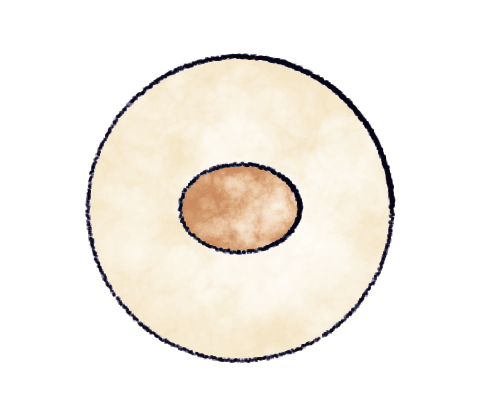
2 Spoon the filling into the middle
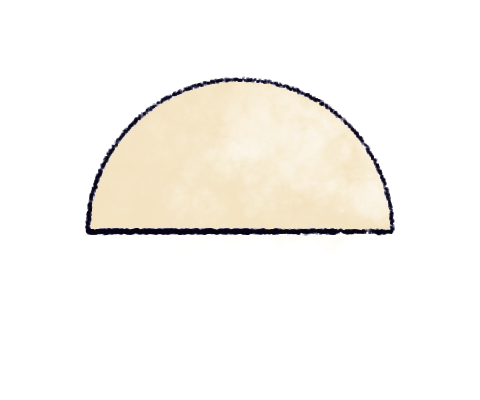
3 Fold it in half over the filling
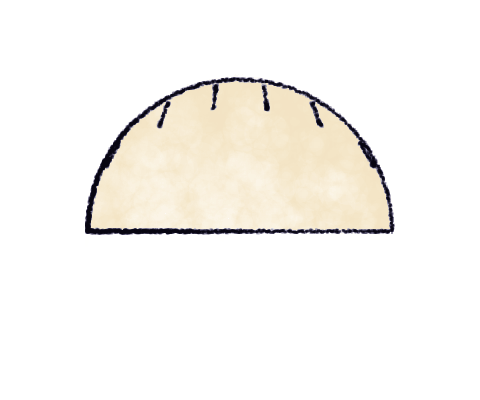
4 Press the edge firmly to seal it
Placeholder diagram. The atlas's illustrated fold animations will replace it.
Ingredients for 4
Dough
Filling
To serve
Method
- Brown the veal, pork and rabbit separately in the oil and butter in a heavy casserole, then return them all to the pot.Timer 10 min
- Add the onion, carrot, celery, garlic and rosemary and cook until the vegetables soften.Timer 5 min
- Pour in the wine and let it bubble away, then add the stock. Cover and cook over the lowest heat until the meat is very tender, adding a splash of stock if it starts to fry.Timer 90 min
- Meanwhile, make the dough. Mix the flour, eggs and salt and knead until smooth and elastic.Timer 10 min
- Wrap the dough and rest it somewhere cool.Timer 60 min
- Wilt the greens in a pan with a little oil until soft, then cook off all their moisture. Squeeze dry.Timer 5 min
- Lift the meat out of the casserole and let it cool. Strain the cooking juices and keep them for the sauce.
- Mince the meat and greens very finely, by knife or in a processor. Mix with the egg, cheese, nutmeg, salt and pepper to a firm, compact paste.
- Roll a piece of dough into a long strip, as thin as you can (about 1 mm), keeping the rest wrapped.
- Set hazelnut-sized balls of filling in a row along the strip, about 1 cm apart and 2 cm in from the long edge nearest you.
- Fold that edge of the dough over the filling and press it down along its length to seal.
- Pinch the dough upright between each ball of filling with thumb and forefinger. This pinch is the plin.
- Run a fluted pasta wheel along the strip to trim the sealed edge, then cut through the middle of each pinch, rolling away from you so the cut folds the dough over into a small pocket.
- Spread the agnolotti on a floured cloth, not touching, and repeat with the rest of the dough.
- Melt the butter with the sage in a wide pan until it foams, and stir in a few spoonfuls of the reserved roasting juices.
- Boil the agnolotti in plenty of lightly salted water at a gentle simmer until they float and the pasta is tender.Timer 3 min
- Lift them out with a slotted spoon, turn them in the butter and juices for a minute, and serve.Timer 1 min
Sources
- Agnolotti del plin piemontesi al canovaccio, ricetta originale, Rebecca Bruni (Scatti di Gusto; recipe by Gianluca Valterza)
- Ravioli del plin, la ricetta della pasta ripiena piemontese, Rossella Neri (Dissapore)
- Agnolotti piemontesi, Dissapore
- Ravioli del plin, il primo piatto del Natale piemontese, Rita Mighela (Gazzetta del Gusto)
Where
From Piedmont.
- OriginPiedmont
Evidence
Good evidence
The word first shows up in 1643, in a Florentine mock-epic poem, and the first recipe we know is for "Agnellotti macheronati" with a capon filling in a Bologna cookbook of 1791. Piedmont's own printed recipes follow in 1854, from Giovanni Vialardi, cook to the House of Savoy. A 1771 Piedmontese cookbook may be earlier, but we haven't seen it. The story of a cook named Angiolino who gave them his name is legend.
Sources
- 1643Earliest record

Vocabolario dinamico dell'italiano moderno – AtLiTeG, lemma 'agnolotto'
AtLiTeG historical dictionary of Italian gastronomic language, entry 'agnolotto': first attestation 'agnellotto' 1643 (Beridio Darpe = Piero de' Bardi, Avino Avolio Ottone e Berlinghier, a Florentine mock-epic poem); first recipe in its corpus…
- 1771

web search snippet (food blog / AIFB page); primary not opened
'Agnellotti all'italiana', lean and meat versions, in La cuciniera piemontese (Vercelli, 1771).
Not yet checked against the original
- 1854
Trattato di cucina, pasticceria moderna, credenza e relativa confettureria (Torino, 1854)
Giovanni Vialardi, cook to the House of Savoy, prints several recipes: 'Zuppa di agnelotti al sugo' (no. 39, pasta sheet, farce dropped in lines, covered, pressed with the fingers, cut round), 'Agnelotti alla borghese' (no. 40, farce of cooked veal,…
- 1854
Parole del cibo in area piemontese
Scholarly study of Piedmontese food words: Vialardi (1854) uses 'agnelotti' (p. 43) as a Piedmontese regionalism; the name may come from Piedmontese agnolòt/agnulòt; DELI (Cortelazzo–Zolli) rejects the 'agnello' (lamb) etymology; cognates agnulòt…
- Undated

A cook from Monferrato called Angiolino/'Angelòt' invented them and gave his name.
The tagline and story are editorial; the facts trace to the research above. How we weigh evidence
Family D
Kin


Compare
