
Big Swabian pasta pockets of meat, spinach and bread.
Swabia · first recorded 1794
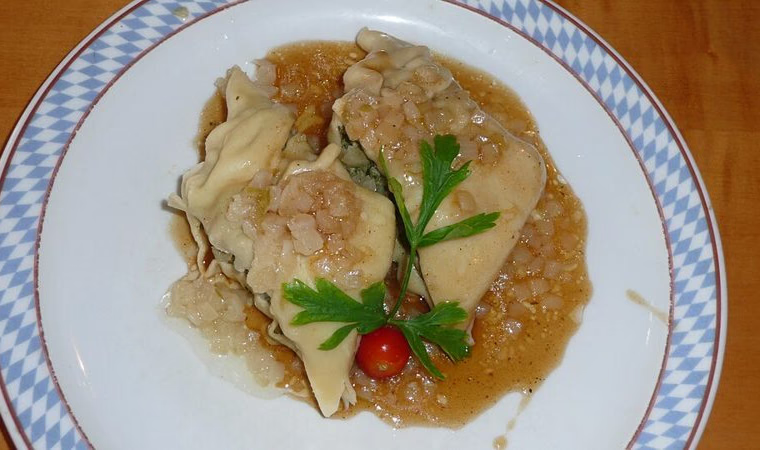 Photo Brücke-Osteuropa · CC0 · Wikimedia Commons
- Wrapper
- Wheat doughLarge rectangles
- Filling
- Meat, spinach, bread, onion
- Cooked
- Boiled, in soup, pan-fried
- Size
- About 5 cm acrossA 15 cm strip folded lengthways twice makes a roll about 5 cm wide, cut into 5 cm sections.
Tastes of
- meat
- spinach
- onion
- nutmeg
Texture
- soft pasta
- dense filling
Field notes
Story
Large Swabian pasta pockets of meat, spinach and bread. Protected as an EU PGI since 2009 for Baden-Württemberg and Bavarian Swabia.
- How to eat it
- In broth, or sliced and fried with egg (geschmälzt).
- When
- Maundy Thursday and Good Friday.
History
Nickname "Herrgottsbscheißerle" ("little God-cheaters"). Luther used "Maultasche" for "slap" in 1531. Recipes under the name in a Leipzig 1794 lexicon (the protected-name specification gives Schmid's Swabian dictionary, 1831, as the first documentary mention). Grimm 1885 = "filled noodle in Swabia". EU PGI 22 Oct 2009 (Reg. 991/2009).
Did you know Legend says Maulbronn monks hid meat inside pasta so God wouldn't see it during Lent, hence "Herrgottsbscheißerle".
Make it
Swabian Maultaschen in broth
- Makes
- about 16 Maultaschen
- Prep
- 90 min
- Cook
- 10 min
- Level
- medium
- Fold
- square seal
How to fold: Half-moon

1 Roll a thin round of dough
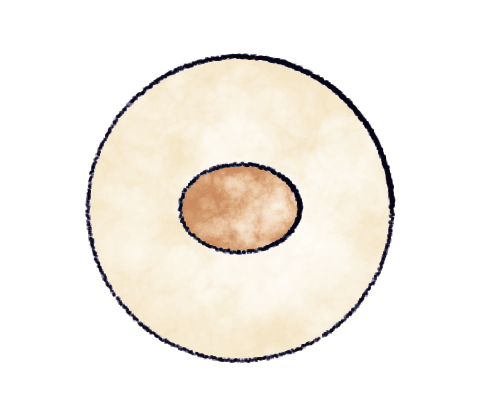
2 Spoon the filling into the middle

3 Fold it in half over the filling
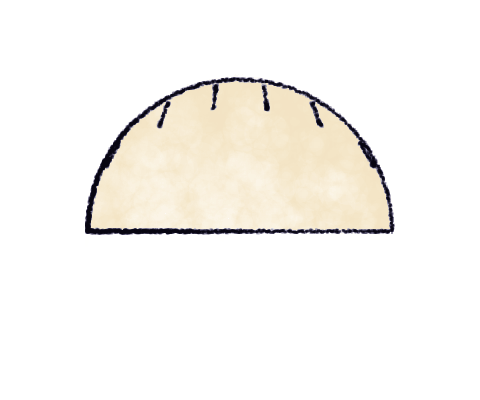
4 Press the edge firmly to seal it
Placeholder diagram. The atlas's illustrated fold animations will replace it.
Ingredients for 4
Dough
Filling
Assembly
To serve
Method
- Knead the flour, eggs, oil, salt and a little water into a firm, smooth pasta dough.Timer 10 min
- Wrap the dough and rest it at room temperature.Timer 30 min
- Wilt the spinach in a pan with a pinch of salt, cool it, squeeze it as dry as you can and chop it finely.
- Soak the roll in water until soft, then squeeze it out well.Timer 10 min
- Soften the onion and bacon in the butter, stir in the parsley for a moment, then leave to cool.Timer 5 min
- Mix the minced meat, sausage meat, spinach, roll, onion mixture and eggs to an even paste. Season with salt, pepper and nutmeg.
- Poach a teaspoon of filling in simmering water, taste it and correct the seasoning. If the mixture is wet, add a few breadcrumbs.
- Halve the dough and roll each piece into a long thin strip about 15 cm wide, by pin or pasta machine.
- Spread half the filling along each strip about 0.5 cm thick, leaving a 4 cm border along one long edge and 1 cm on the others.
- Brush the bare edges with egg yolk, then fold the strip over itself lengthways twice to make a flat roll with the seam underneath.
- Press the roll into 5 cm sections with the handle of a wooden spoon, cut them apart and pinch the cut ends closed.
- Fry the onion rings slowly in butter or oil until golden brown.Timer 12 min
- Bring the broth to the boil, lower it to a simmer and slide in the Maultaschen. Poach gently; they must not boil hard.Timer 10 min
- Serve three or four per person in the hot broth, topped with the fried onions and chives.
Sources
- Schwäbische Maultaschen (Kulinarisches Erbe), Tourismusverband Allgäu/Bayerisch-Schwaben
- Schwäbische Maultaschen, LECKER (kochen & genießen)
- Schwäbische Maultaschen, SRF 1
Where
From Swabia (Württemberg).
- Protected areaSwabia (BW + Bavarian Swabia) · Swabia · Swabians
- Claimed originMaulbronn Abbey (legend) · Swabia
Protected name
EU PGI · Schwäbische Maultaschen / Schwäbische Suppenmaultaschen
Reg. (EC) No 991/2009 of 22 Oct 2009 (OJ L 278, 23.10.2009), amended by Reg. (EU) 2015/193 · registered 2009-10-23
Protected area: All of Baden-Württemberg plus the Regierungsbezirk Schwaben in Bavaria
The Maulbronn monks' origin story is a legend.
Evidence
Good evidence
Recipes under the name appear in a Leipzig cookery lexicon of 1794, the oldest we know of, though the protected-name specification gives 1831, Schmid's Swabian dictionary, as the first documentary mention. When Luther used the word "Maultasche" in 1531 he meant a slap in the face, not food. By 1885 the Grimms' dictionary defined it as a filled noodle from Swabia. The much-loved tale of Maulbronn monks hiding meat from God during Lent is legend.
Sources
- 1794Earliest record

Allgemeines Küchenlexicon für Frauenzimmer, II. Theil (Leipzig, Voß und Breitkopf, 1794)
German Wikipedia cites the Allgemeines Küchenlexicon für Frauenzimmer, part II, Leipzig 1794, cols. 124–125, for several recipes under the name; the English article calls it 'a cookbook originating in Leipzig in 1794'. A digitised copy of part II…
Not yet checked against the original
- 1831
Schwäbische Maultaschen / Schwäbische Suppenmaultaschen, specification (DPMA register)
The protected-name specification gives 1831 as the first documentary mention, when the Württemberg prelate Johann Christoph von Schmid (1756–1827; the specification spells him 'Johannes Christoph'; the 1831 dictionary is posthumous) described the…
Confirmed by web search; not yet read in full
- 1831

Schwaebisches Wörterbuch, mit etymologischen und historischen Anmerkungen
Johann Christoph von Schmid's Schwäbisches Wörterbuch is in full view on HathiTrust (University of Michigan copy); the Maultasche entry was not seen.
Confirmed by web search; not yet read in full
- 2009
Commission Regulation (EC) No 991/2009
Commission Regulation (EC) No 991/2009 of 22 October 2009 (OJ L 278, 23.10.2009, p. 5) entered 'Schwäbische Maultaschen' / 'Schwäbische Suppenmaultaschen' in the register of protected geographical indications (class 2.7, pasta).
Confirmed by web search; not yet read in full
- Undated

Legend: the monks of Maulbronn hid meat inside pasta to eat it in Lent, hence the nickname 'Herrgottsbscheißerle' (little God-cheaters). Anecdotal, undated.
Confirmed by web search; not yet read in full
The tagline and story are editorial; the facts trace to the research above. How we weigh evidence
Family D


