
From Kanak, New Caledonia.
- Region
- Pacific Islands
- First record
- 1932 · Modern & global
- Fold
- Leaf parcel or pillow
- Cooked
- Steamed with hot stones or in an earth oven
- Dough
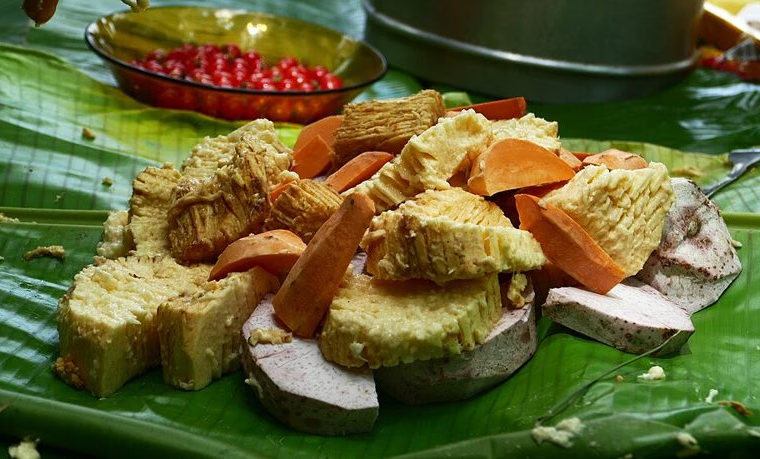
- Potato doughLeaf-wrapped feast parcel
- Made with
- Yam, taro, sweet potato, meat, coconut milk
- Cooked
- Steamed with hot stones or in an earth oven
- Size
- About 14 cm across
- Note
- A borderline case: it stretches the definition of a dumpling.
Not known yet We don’t yet have a written story, a recipe or a precise place of origin for Bougna. What we do have is below, with its sources.
Where
Open the map →
Evidence
Well established. An archaeological find or a primary source backs it.
We list 6 sources: 3 primary or archaeological, 3 secondary. How grading works.
First record Bulletin du Commerce de la Nouvelle-Calédonie, 17 Feb 1932: "un énorme bougnat", meat cooked on heated stones with bananas, taro and yams (A); first found, a 1912 newspaper hit could not be opened
Strongest sources
- A
Local news item headed 'Plum': the owner of the Plum farm organised Kanak dances and songs for wealthy tourists. 'Après les danses et les chants, il y eut la confection d'un énorme " bougnat " où un bœuf entier fut cuit…
Local news item headed 'Plum': the owner of the Plum farm organised Kanak dances and songs for wealthy tourists. 'Après les danses et les chants, il y eut la confection d'un énorme " bougnat " où un bœuf entier fut cuit en compagnie de bananes, tarots ignames traditionnels. Ce ne fut pas un spectacle banal que de voir sous les grands arbres de la plage ... une cinquantaine de beaux indigènes, hommes et femmes couverts des feuilles de palmiers ... s'agiter autour du grand feu qui chauffait les cailloux.' (OCR lightly corrected: 'binai' -> 'banal', 'li plage' -> 'la plage'.) - A
Le Bulletin du Commerce de la Nouvelle-Calédonie et des Nouvelles-Hébrides, 10 February 1917
Negative check: the only Gallica hit for 'bounia' in the Bulletin du Commerce before 1932 (issue of 10 Feb 1917) is a personal name in a subscription list ('Bounia 2, Toupane 2'), not the dish. Within that newspaper's…
Negative check: the only Gallica hit for 'bounia' in the Bulletin du Commerce before 1932 (issue of 10 Feb 1917) is a personal name in a subscription list ('Bounia 2, Toupane 2'), not the dish. Within that newspaper's Gallica run the spelling 'bougna(t)' first appears in the 1932 issue above, then in 1936-1938 issues (not opened). - A
O'Reilly, p. 208: 'Le menu du déjeuner offert par le Conseil général de la Nouvelle-Calédonie le 24 septembre 1953 portait : « Présentation et dégustation de Bougnat. » Il s'agit d'une préparation culinaire propre aux…
O'Reilly, p. 208: 'Le menu du déjeuner offert par le Conseil général de la Nouvelle-Calédonie le 24 septembre 1953 portait : « Présentation et dégustation de Bougnat. » Il s'agit d'une préparation culinaire propre aux îles Loyalty. « Dans la case ronde et immense de Zéoula, ce plat national nous est offert avec tout le cérémonial habituel. Le bounia se compose d'un mélange de bananes, de noix de coco râpée, de légumes divers entourant un poisson de choix ... » (Dr L. Colin. Carnet de route d'un médecin, p. 79).' 'Bounia' is also in the article's index of New Caledonian French words (p. 227).
Show all 6 sources
- S
La Dépêche coloniale, 11 April 1912 (Gallica search hit only)
Unverified lead, possibly the oldest: Gallica's full-text index returns the issue of La Dépêche coloniale of 11 April 1912 for 'bounia' together with 'Loyalty'. The page text could not be fetched (HTTP 429, then 403),…
Unverified lead, possibly the oldest: Gallica's full-text index returns the issue of La Dépêche coloniale of 11 April 1912 for 'bounia' together with 'Loyalty'. The page text could not be fetched (HTTP 429, then 403), so the passage was NOT read; it may be the serialised 'Carnet de route d'un médecin' that O'Reilly quotes, or an unrelated OCR hit. - S
Abstract: 'bougna' is the New Caledonian French name of the emblematic Kanak dish; called bunyâ in Iaai (Ouvéa), itra in Drehu (Lifou), aël in Nengone (Maré); one of a group of Oceanic leaf-wrapped taro/yam and…
Abstract: 'bougna' is the New Caledonian French name of the emblematic Kanak dish; called bunyâ in Iaai (Ouvéa), itra in Drehu (Lifou), aël in Nengone (Maré); one of a group of Oceanic leaf-wrapped taro/yam and coconut-cream preparations (lablab in Dorig, loko in Mota, takihi in Niue). No first attestation is given. - S
Bougna (en.wikipedia); 'bougna' (lalanguefrancaise.com)
The word comes from Drehu 'puhnya', 'bundle' (marked 'citation needed' on Wikipedia); a French dictionary site gives Kumak 'bunya' and Drehu 'puhnya'. Neither gives a date.
Family H
Kin
More leaf-wrapped grain parcels (separate inventions)