
Rice balls with a palm-sugar centre.
Cambodia · first recorded 1902
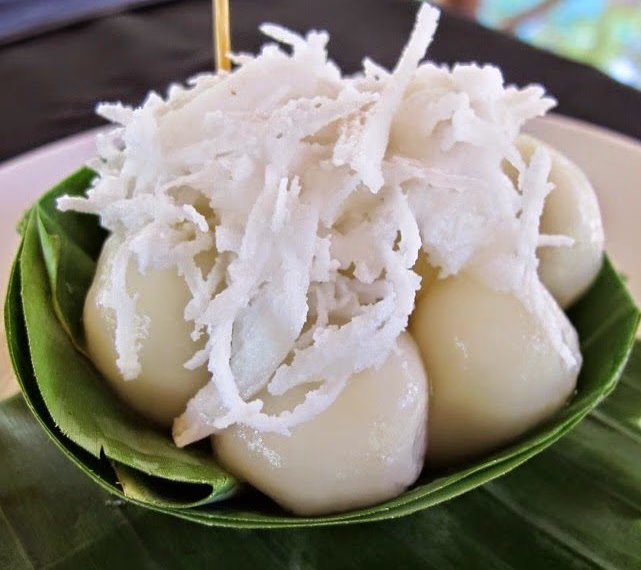 Photo Hyzuko · CC BY-SA 4.0 · Wikimedia Commons
- Wrapper
- Rice or wheat doughFilled; sweet balls
- Filling
- Glutinous rice flour; palm-sugar centre
- Cooked
- Boiled
- Size
- About 3 cm acrossA walnut-sized piece closed round the sugar into a ball is about 3 cm.
Tastes of
- palm sugar
- coconut
Texture
- sticky
Field notes
Story
Cambodian balls of glutinous rice flour with a palm-sugar centre, boiled and rolled in coconut.
- How to eat it
- Rolled in coconut and served in banana-leaf cups.
Did you know The nickname "husband-killing cake" comes from a legend about the hot sugar bursting out.
Make it
Num plae ai (Cambodian palm sugar rice balls in coconut)
- Makes
- about 16–20 balls
- Prep
- 30 min
- Cook
- 10 min
- Level
- easy
Ingredients for 4
Dough
Filling
Coating
To serve
Method
- Cut the palm sugar into small pieces, one for each ball.
- Grate the coconut and keep it in the fridge until needed.
- Mix the flour and salt, then work in the water a little at a time to make a smooth, soft dough that does not crack.
- Pinch off a walnut-sized piece of dough and press it into a small cup.
- Put a piece of palm sugar in the cup, close the dough over it and roll it into a ball with no gaps. Repeat with the rest.
- Bring a large pan of water to the boil with a pinch of salt, then lower the heat to a gentle simmer.
- Lower the balls into the water and cook gently until they float, which takes 5–10 minutes.Timer 8 min
- Lift them out into a bowl of cool water for a minute, then drain.Timer 1 min
- Roll each ball in the grated coconut, mixed with the sesame if using.
- Serve warm or cold, in banana-leaf cups if you have them. Bite carefully, as the melted sugar inside can be very hot.
Sources
- Khmer Memories – Num Plae Ai/Sticky Rice Sweet Balls, Dosaikal
- Num plae ai, Wikipedia
Where
From Cambodia.
Evidence
Good evidence
Its name appears in Bernard's 1902 Cambodian-French dictionary, as "phàl ai" in a long list of Cambodian cakes. The entry names it but doesn't describe it, so we can't tell what it was like then. The nickname "husband-killing cake", about a bride whose hot rice balls choke her greedy husband, is legend.
Sources
- 1902Earliest record

Dictionnaire cambodgien-français (entry NOM)
Headword NOM: 'Pain, gâteau (en général). [...] — ânsâm, — kom, — kângvin, — réach chien, — tien, — khuhey, — tréap lengo, — thâk kachân, — bânchôk, — akôr, — khép, — khlàut, — phàl ai, — lot, — banhbêu, — chting... différents gâteaux, très goûtés…
- Undated

Modern description (glutinous rice flour balls filled with palm sugar, rolled in coconut); cites the Cambodian-English Dictionary (1977) only for the words num and plae; no dated history.
- Undated

Popular nickname 'kill-husband cake', explained by a folk tale told in travel writing in conflicting versions (a bride's husband chokes on the hot balls; or a betrayed wife's revenge); no scholarly or Khmer folklore source found.
Confirmed by web search; not yet read in full
The tagline and story are editorial; the facts trace to the research above. How we weigh evidence
Family G


