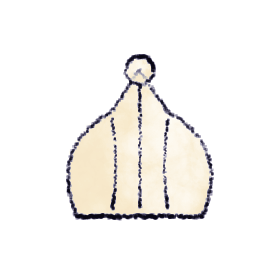
Shish barak
شيش بركshīsh baraksay sheesh BAH-rak
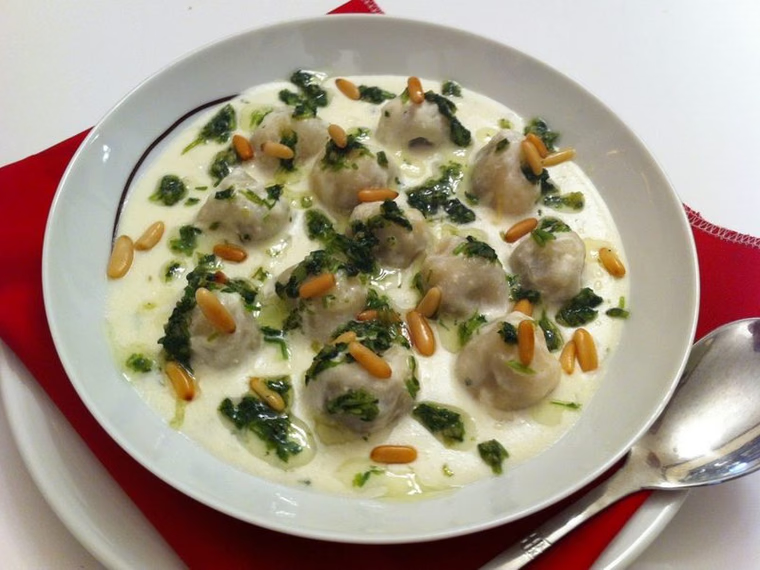
Lamb's ears in warm yoghurt.

- Region
- Arab world and Levant
- First record
- 1250 · Islamic & Mongol world
- Fold
- Ring
- Cooked
- Baked, simmered in yoghurt
- Wrapper
- Wheat doughSmall "ear" with joined ends
- Filling
- Lamb, onion, pine nut
- Cooked
- Baked, simmered in yoghurt
- Size
- About 2 cm across
Tastes of
- lamb
- pine nuts
- yoghurt
- garlic
- coriander
Texture
- tender in silky sauce
Field notes
Story
Small Levantine lamb dumplings cooked in garlicky yoghurt sauce; today they are often baked first. The earliest confirmed Arabic recipe, Ibn al-Mubarrad's from 15th-century Damascus, boiled them.
- How to eat it
- Spoon over rice with the yoghurt sauce.
- When
- Family meals.
History
Name from Persian joshpara, "boiled bit" (Perry), later gosh-e barreh in Iran. Earliest Arabic recipe Ibn al-Mubarrad, 15th-c. Damascus (D).
Did you know The name comes from Persian joshpara, "boiled bit"; Iranians later called the dish gosh-e barreh, "lamb's ear".
Where
From Levant (Lebanon, Syria, Palestine, Jordan).
Pin · Damascus (al-Salihiyya), where Ibn al-Mubarrad wrote the earliest recipe; the name itself is Persian, so the dish's deeper origin is east of here
- OriginLevant · Bilad al-Sham · Levantine Arabs
Evidence
Fairly sure. A dated text records it by 1250.
We list 6 sources: 4 dated texts, 2 secondary. How grading works.
First record Kitab al-Wusla ila l-habib, 13th-c. Syria, names shushbarak (D, Perry 2017); first recipe Ibn al-Mubarrad, 15th-c. Damascus (D)
Strongest sources
- D
The 13th-c. Syrian Kitab al-Wusla ila l-habib (anonymous, sometimes attributed to Ibn al-'Adim of Aleppo, d. 1262) names shushbarak and its shape but gives no recipe.
- D
Earliest recipe: "You take minced meat and stuff it in dough rolled out like cut tutmaj. It is cooked in water until done. Then take it off the fire and put yoghurt, garlic and mint with it." (Ibn al-Mubarrad / Ibn…
Earliest recipe: "You take minced meat and stuff it in dough rolled out like cut tutmaj. It is cooked in water until done. Then take it off the fire and put yoghurt, garlic and mint with it." (Ibn al-Mubarrad / Ibn al-Mibrad, Kitab al-Tibakha, Damascus, 15th c.; author lived c. 1437/40-1503) - D
A Miscellany (Ibn al-Mabrad p. 20)
Same text also has 'salma', dough pieces "struck like a coin with a finger", boiled, served with yoghurt, fried meat, mint and garlic (sister dish; Perry p. 20).
Show all 6 sources
- D
1885 Beirut cookbook (Khalil Khattar Sarkis, Ustadh al-Tabbakhin) describes shishbarak: small meat/onion/coriander dumpling cooked in broth and sour milk (reported in Actes du 8e Congrès int. des orientalistes, Brill 1891).
- S
Mediaeval Egyptian ravioli (شيشبرك, shishbarak)
Shishbarak "is found in 13th- and 15th-century Egyptian cookery books"; dough made like tutmaj, round pieces stuffed with meat, spikenard, saffron, onion, mint, folded like ravioli, boiled, served with yoghurt or…
Shishbarak "is found in 13th- and 15th-century Egyptian cookery books"; dough made like tutmaj, round pieces stuffed with meat, spikenard, saffron, onion, mint, folded like ravioli, boiled, served with yoghurt or pomegranate extract; name "betrays a Turkish origin", possibly brought by Turkic tribes. (Blog post by a Durham Arabist; the specific cookbooks are NOT named on the page.) - S
'joshpara', Oxford Companion to Food (2014), p. 434 — via Wikipedia 'Joshpara'
Etymology (Perry): Persian joshpara, josh "to boil" + para "bit"(?), earlier joshparag before the 10th c.; Arabised as shushbarak / shishbarak. Modern Persian replaced it with gosh-e barreh "lamb's ear" (a later re-shaping, not the source).
Found by research and reviewed, October 2026.
The tagline and story are editorial; facts trace to the atlas research.
Family B