
Leek dumplings under yoghurt and meat sauce.
Afghanistan · on record since 1972
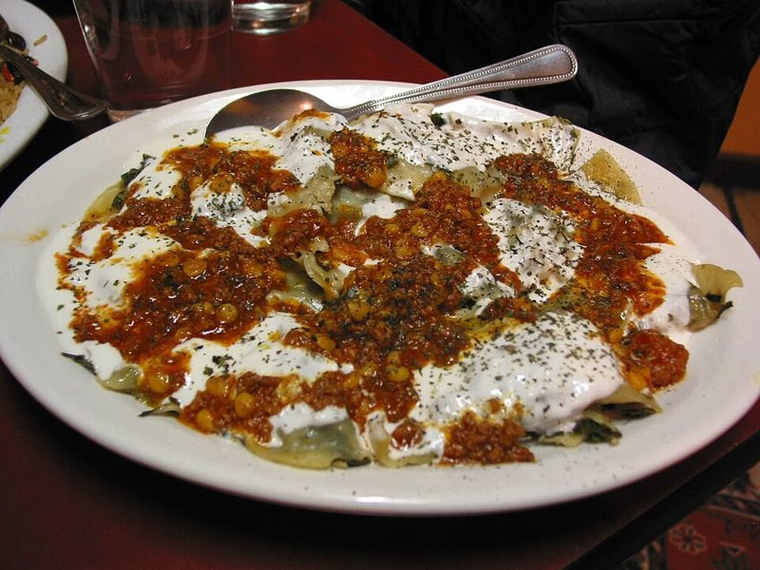 Photo Arnold Gatilao · CC BY 2.0 · Wikimedia Commons
- Wrapper
- Wheat doughThin
- Filling
- Gandana (leek/chive)
- Cooked
- Boiled
- Size
- About 7 cm acrossA 7 cm round or square folded in half is about 7 cm along the fold.
Tastes of
- gandana leek
- garlic yoghurt
- meat sauce
- dried mint
Texture
- soft
Field notes
Story
Afghan boiled dumplings filled with gandana (garlic chives or leek), layered with garlic yoghurt and a meat or lentil sauce, and finished with dried mint.
- How to eat it
- Layered on a platter with yoghurt and sauce.
- When
- Eid, weddings.
Did you know Its filling is leek or chives, but it is usually served under a meat sauce, and it is boiled where mantu is steamed.
Make it
Ashak (gandana dumplings with garlic yoghurt and meat sauce)
- Makes
- about 50–60 dumplings
- Prep
- 2 hours
- Cook
- 45 min
- Level
- medium
- Fold
- half moon
How to fold: Half-moon

1 Roll a thin round of dough
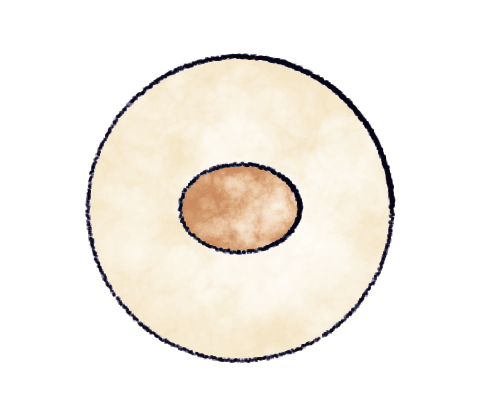
2 Spoon the filling into the middle

3 Fold it in half over the filling
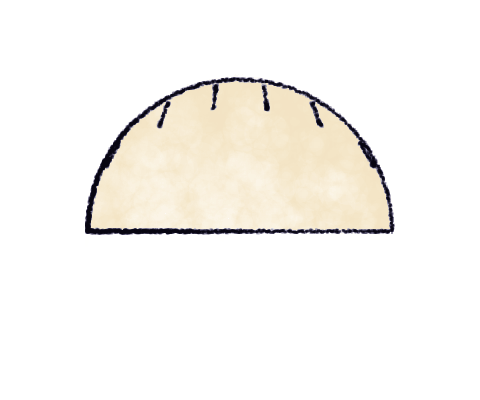
4 Press the edge firmly to seal it
Placeholder diagram. The atlas's illustrated fold animations will replace it.
Ingredients for 6
Dough
Filling
Meat sauce
Garlic yoghurt
To serve
Method
- Mix the flour, salt and oil, then add the water gradually until a firm dough forms.
- Knead until smooth and elastic.Timer 9 min
- Cover the dough and rest it in the fridge.Timer 30 min
- For the sauce, fry the onion in the oil until golden, then add the garlic.Timer 7 min
- Add the mince and cook, breaking it up, until browned.Timer 10 min
- Stir in the tomato, coriander, paprika, salt, pepper and water. Cover and simmer on low heat.Timer 25 min
- Mix the chopped greens with the butter, salt, pepper and chilli.
- Stir the garlic into the yoghurt, thinning it with a spoonful of water if it is very thick.
- Roll the dough in batches to about 1.5 mm, by hand or through a pasta machine, dusting with flour.
- Cut rounds or squares about 7 cm across.
- Put a teaspoon of filling in the middle of each, moisten the edge with water, fold in half and press firmly to seal.
- Bring a large pot of salted water to the boil and cook the ashak in batches until they float and turn over.Timer 4 min
- Lift out with a slotted spoon and drain well.
- Spread most of the yoghurt on a warm platter and lay the ashak on top.
- Spoon over the hot meat sauce and the rest of the yoghurt, and scatter with dried mint.
Sources
- Afghan dumplings with beef sauce and garlic yoghurt (ashak), Breshna Keshtiar (SBS Food)
- Afghan dumplings with spiced lamb and yogurt (aushak), Humaira Ghilzai and Katie Morford (Afghan Culture Unveiled)
- Afghan Aushak, The Curious Chickpea
Where
From Afghanistan.
- OriginAfghanistan · Khorasan · Pashtuns, Tajiks, Uzbeks
Evidence
Reference works only
Nancy Hatch Dupree's 1972 guide to Kabul gives the earliest description we've found: "a ravioli-type pasta stuffed with leeks and smothered with a meat sauce topped with sour cream". Reference works on Afghan cooking agree it is one of the country's important filled pastas. It's the earliest record we've reached, not when the dish began, and its wider family goes back to shish barak around 1250.
Sources
- Undated

ĀŠPAZĪ (cookery), Encyclopaedia Iranica (1987, updated 2016)
āšak named (with āš, mantū, ḡōšbāra, qūš-tīlī) as one of the stuffed-pasta 'ravioli' preparations that "still occupy an important place" in the present-day cookery of Afghanistan and neighbouring Central Asian states.
- Undated
Afghan Food & Cookery: Noshe Djan (Prospect Books 1986; Hippocrene 2000)
Helen Saberi, Noshe Djan: Afghan Food and Cookery (Prospect Books 1986; rev. eds.) — standard English reference on Afghan food; an ashak recipe is expected but was not seen in search snippets.
Not yet checked against the original
- Undated

Aushak/ashak: Afghan pasta dumplings filled with chives, with a (frequently meaty) tomato sauce, yoghurt and dried mint; time-consuming, served on holidays and special gatherings. (Wikipedia's citations are a food.com recipe, Eskin 2014 and a…
The tagline and story are editorial; the facts trace to the research above. How we weigh evidence
Family B


