
- Region
- Russia, Ukraine, Belarus
- First record
- 1886 · Empires & migration
- Fold
- Ring
- Cooked
- Boiled
Anatomy
Inside
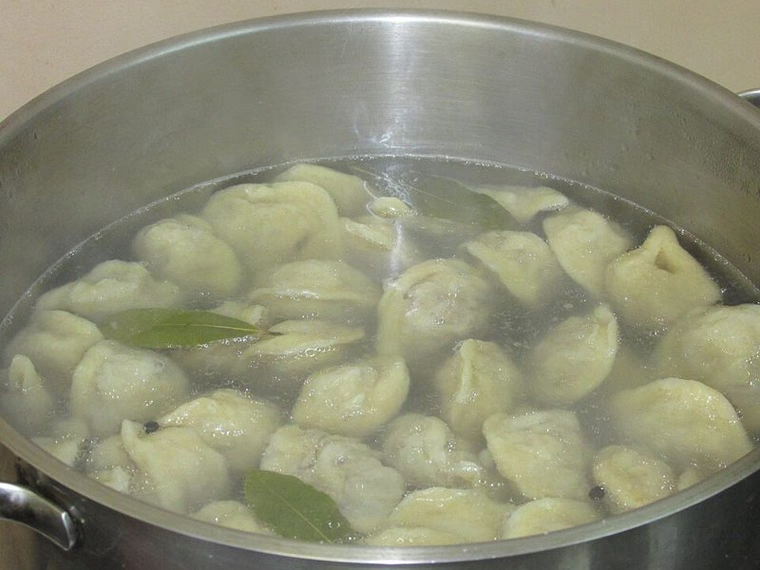
- Wrapper
- Wheat dough
- Filling
- Meat, mushroom, cabbage, berries
- Cooked
- Boiled
- Served
- Autumn task; International Pelmen Day
- Size
- About 2 cm across
Make it
Udmurt pelnyan with three meats and a rye-wheat dough
How to fold: Ring (ear)

1 A little filling on a small round
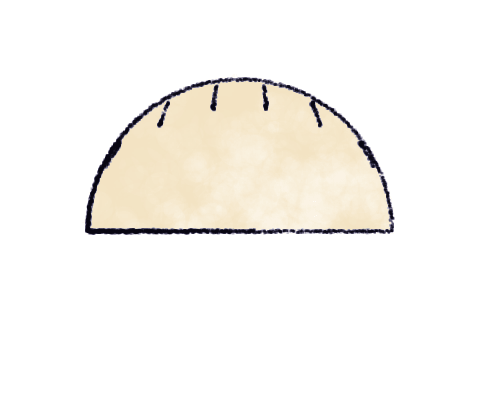
2 Fold into a half-moon and seal

3 Bend the two corners down and round
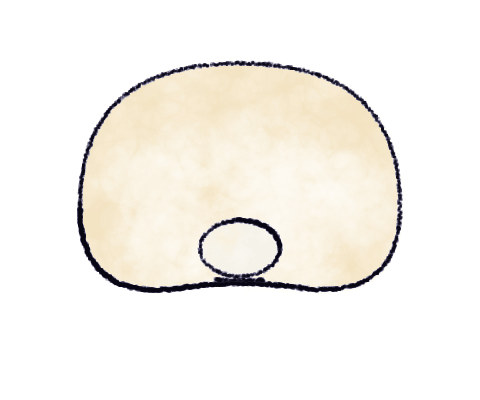
4 Pinch the corners together: a ring, like an ear
Placeholder diagram. The atlas's illustrated fold animations will replace it.
Ingredients for 4
Dough
Filling
To serve
Method
- Mix both flours with the salt. Beat the egg into the water and stir it into the flour.
- Knead until stiff and smooth, about 10 minutes; rye makes the dough a little less stretchy than an all-wheat one. · timer 10 min
- Wrap the dough and let it rest. · timer 20 min
- Grind the beef, lamb, pork, fat and onion together, ideally twice, first coarse and then fine.
- Season with salt and pepper, add the cold water and mix until sticky.
- Roll the dough thin, about 1.5 mm, and cut rounds about 5 cm across.
- Put a scant teaspoon of filling on each round.
- Fold the round over into a half-moon and press the edges together, leaving a small gap at one end so the juices can mix with the cooking broth.
- Bring the two corners together and pinch them into an ear shape.
- Set the dumplings on a floured tray. Freeze them if not cooking straight away.
- Boil in plenty of salted water in batches, stirring once. Once they float, cook about 5 minutes more. · timer 5 min
- Lift out and serve hot with melted butter and sour cream, or in a bowl of the broth.
Notes. Pelnyan is the Udmurt form of the Ural pelmen, and the Russian word pelmeni is usually traced to it: pel (ear) and nyan (bread). It differs from standard Russian pelmeni in three ways that Udmurt sources stress: the dough often contains rye flour; the filling is a mix of three meats with pork fat; and some cooks deliberately leave one edge of the ear unsealed so the filling takes in broth. Other cooks seal them fully, so treat the open edge as a local practice, not a rule. Udmurt cooks also fill pelnyan with mushrooms, fresh or fermented cabbage, grated radish with sour cream (kushman pelnyan), curd cheese, potato, fish, liver, or wild berries such as raspberries for a sweet version. For a cabbage filling, stew 500 g finely shredded cabbage with an onion in butter until soft and season well. Pelnyan were festive food for honoured guests and were frozen in large batches through the winter.
Written for the atlas from several sources, cross-checked: Пельнянь удмуртский (Udmurt pelnyan), Gastronom.ru; Пельмени - Пельнянь (Udmurt cuisine), food-udm.ru; Как сделать пельмени по-удмуртски (How to make Udmurt pelmeni), AiF Udmurtia; Что такое удмуртская кухня (What is Udmurt cuisine), Food.ru. Not yet kitchen-tested.
Range
Where
From Udmurtia.
Pin · Izhevsk · region (first-level subdivision), not a town
- OriginUdmurtia · Volga-Ural · region (first-level subdivision) · Udmurts
How sure we are
Evidence
Well established. An archaeological find or a primary source backs it.
We list 4 sources: 1 primary or archaeological, 1 dated text, 2 secondary. How grading works.
First record Vereshchagin, Votyaki Sosnovskogo kraya, 1886, p. 14: "pelnyan", pork dumplings in rye dough without eggs, made for Christmas (A); first found
Sources
- A
p. 14, section "Кушанья": "10) Пельнянь - пельмени со свининой, но тѣсто изъ ржаной муки, безъ яицъ." (the next item, перепечь, is described as chopped "не такъ мелко, какъ на пельмени"). p. 12: "къ Рождеству Христову…
p. 14, section "Кушанья": "10) Пельнянь - пельмени со свининой, но тѣсто изъ ржаной муки, безъ яицъ." (the next item, перепечь, is described as chopped "не такъ мелко, какъ на пельмени"). p. 12: "къ Рождеству Христову заготовляютъ пельмени на весь праздникъ пудовки по двѣ и по три; пельмени ѣдятъ безъ уксусу и перцу." Page numbers read from the scan (leaves n25 and n23). - D
Syrjänisches Lehngut im Russischen, Finnisch-ugrische Forschungen 18 (Helsingfors, 1927), pp. 35-36
Kalima 1927, p. 36: Udmurt may also be the lending language of Russian пельмень, "vgl. wot. Munk. pelnan 'mit gehacktem fleische u. zwiebel gefuelltes toertchen'" - i.e. Munkacsi's Votyak dictionary has the word with…
Kalima 1927, p. 36: Udmurt may also be the lending language of Russian пельмень, "vgl. wot. Munk. pelnan 'mit gehacktem fleische u. zwiebel gefuelltes toertchen'" - i.e. Munkacsi's Votyak dictionary has the word with that gloss. Munkacsi's dictionary was not opened (its year is not given by Kalima at this place), so this is second-hand. - S
Этимологический словарь русского языка, entry пельмень (online transcription)
"Заимств. из коми, удм. реl'ńаń от коми, удм. реl' «ухо», ńań «хлеб», из-за формы, которую имеют эти изделия (Калима, FUF 18, 35 и сл.)". Names Udmurt explicitly, but gives no date of first record. FUF began in 1901, so…
"Заимств. из коми, удм. реl'ńаń от коми, удм. реl' «ухо», ńań «хлеб», из-за формы, которую имеют эти изделия (Калима, FUF 18, 35 и сл.)". Names Udmurt explicitly, but gives no date of first record. FUF began in 1901, so vol. 18 is 20th-century; its year was not verified. Dal (see komi entry) names Permyak or Vogul instead and does not mention the Votyaks. - S
Finnisch-ugrische Forschungen 18, pp. 35 ff. — as cited by Vasmer
Kalima's article in FUF 18, pp. 35 ff., is the scholarly source for the Komi/Udmurt etymology. Reported by Vasmer only; article not opened, year not verified.
Found by research in October 2026; awaiting editorial review.
Notes from the research
Source of the word "pelmeni" (Davidson, Oxford Companion to Food, 2014 ed.). Goldstein (2022) credits Komi-Permyak instead. Contested
Cited: Wikipedia "Udmurt cuisine"; Hamilton College project; Wikiwand "Pelmeni" (citing Goldstein 2022)
History sources are from the atlas and not yet independently checked.
Family C