
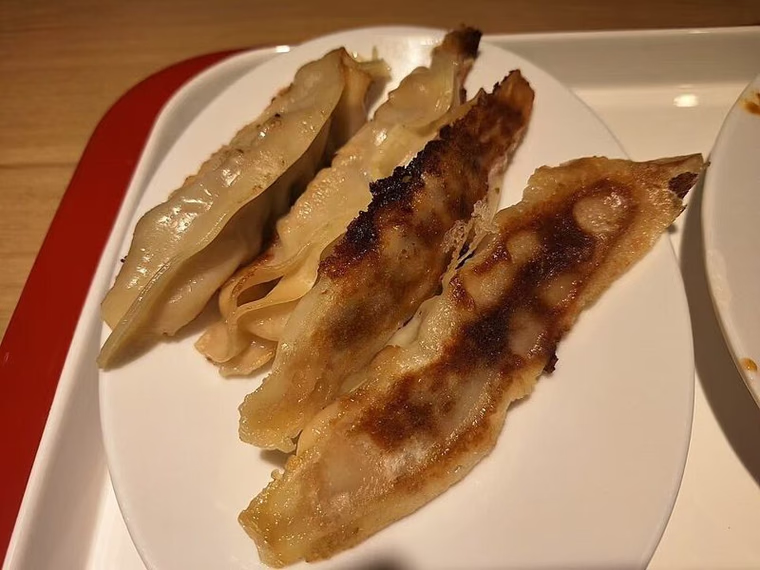
Dumplings fried until they stick to the pan, then steamed.
North China · first recorded 1903
- Wrapper
- Wheat dough
- Filling
- As jiaozi
- Cooked
- Pan-fried, steamed
- Size
- MediumAn estimate, about 6 cm across: no source gives a measure yet.
Tastes of
- vinegar dip
Field notes
Story
North Chinese dumplings made like jiaozi, pan-fried and then steamed. Beijing guotie are often left open at the ends. The name means "pot-sticker".
- How to eat it
- With a vinegar dip.
- When
- Street food.
Did you know Japanese yaki-gyoza and Korean gun-mandu descend from it.
Make it
Guotie (northern Chinese pork pot-stickers)
- Makes
- about 18 dumplings
- Prep
- 60 min
- Cook
- 16 min
- Level
- medium
- Fold
- half moon
How to fold: Half-moon

1 Roll a thin round of dough

2 Spoon the filling into the middle

3 Fold it in half over the filling
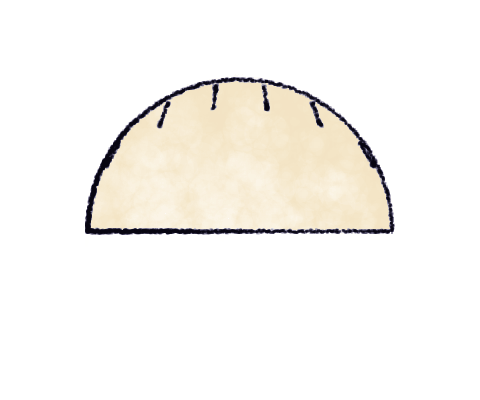
4 Press the edge firmly to seal it
Placeholder diagram. The atlas's illustrated fold animations will replace it.
Ingredients for 3
Dough
Filling
Cooking
To serve
Method
- Mix the flour and salt, stir in the boiling water with chopsticks, then add the cold water and bring together into a rough dough.
- Knead until smooth.Timer 8 min
- Cover the dough and leave it to rest.Timer 20 min
- Stir the pork with the stock, wine, soy sauces, sugar, salt and pepper in one direction until sticky.
- Fold in the Chinese leaf, ginger, spring onion and sesame oil.
- Knead the dough again briefly, roll it into a log and cut it into 18 pieces. Keep them covered.
- Roll each piece into a thin round, slightly thicker in the middle than at the edge.
- Lay a line of filling, about 2 teaspoons, across the middle of a wrapper.
- Fold the wrapper over and pinch the middle of the edge shut, leaving a small gap open at each end, to make a long, narrow dumpling. Press it gently so it sits flat.
- Heat the oil in a large frying pan with a lid over medium-high heat. Set the dumplings in flat-side down, close together.
- Fry until the bases are lightly browned.Timer 2 min
- Pour in the 150 ml water, cover at once and cook over medium heat until most of the water has gone.Timer 12 min
- Take off the lid and fry until the bases are crisp and release from the pan. Do not turn the dumplings.Timer 2 min
- Turn out crisp side up and serve with vinegar for dipping, and chilli oil or soy sauce if you like.
Sources
- Beijing (Peking) Dumplings – Guotie and Jiaozi, Ken Hom (The Happy Foodie)
- Crispy Pork and Chive Potstickers (Guo Tie), Lin (Woks of Love)
- Homemade Pot Stickers (锅贴), PatriCa BB (My Wok Life)
Where
From North China (Beijing guotie often open-ended). Popular in global "potsticker".
- OriginNorth China · Han
Evidence
Good evidence
The word guotie turns up in inn scenes from the sequels to the Qing novel Shi gong'an, complete by 1903, and in Xu Ke's Qing bai lei chao of 1916-17. These name the dish but don't say how it was cooked. Origin stories involving Mongol nomads, the Empress Dowager Cixi or a Song emperor have no reliable source.
Sources
- 1798-1903Earliest record

Dating of the novel: the original 97 chapters carry a preface dated Jiaqing 3 (1798) and an 1820 edition is in the British Museum (per Liu Ts'un-yan); the book was continued again and again, 'by Guangxu 29 it had reached ten sequels, 528 chapters'.…
- by 1903

施公案 第215回 (Wikisource transcription; text read in the search API extract)
Inn scene: '托著一大盤麵食、點心、牛肉、雞子、餑餑、薄餅、鍋貼、包子,大家飲酒用點膳。'
- by 1903
施公案 第420回 (Wikisource transcription)
Inn scene: '賣的是面飯,肉饅頭、糖饅頭、鍋貼兒、大餅通有的'... '你就再給咱薄餅打上四十張,鍋貼兒做二十個,再拿兩碟甜醬就得了。'
- 1916-1917
清稗類鈔, 飲食類 (Wikisource transcription, section 106)
Entry 扁食: '北方俗語,凡餌之屬,水餃、鍋貼之屬,統稱為扁食,蓋始於明時也。' The entry 餃 in the same section adds that jiao may be 'steamed or pan-fried' (蒸食、煎食皆可).
- Undated
檮杌萃編 第12回 (Wikisource transcription; search API extract)
Late-Qing novel: a courtesan-house servant asks what snack is wanted and the guest says '做點鍋貼來吃吃罷'. Date of the novel not verified in this pass.
- Undated

Web articles on guotie (search-result summaries)
Search summaries attribute a Song-dynasty Kaifeng origin to the 中国烹饪百科全书; the encyclopedia was not opened and no Song text is quoted.
Confirmed by web search; not yet read in full
- Undated

Three origin stories (Mongol nomads; Cixi's discarded dumplings; Song Taizu in Jianlong 3 = 962) are given without sources; the article itself says the Cixi story has 'no reliable source' and is flagged for insufficient citations.
The tagline and story are editorial; the facts trace to the research above. How we weigh evidence
Family A
Kin


Compare
