Siu mai
燒賣siu1 maai6say see-oo MY
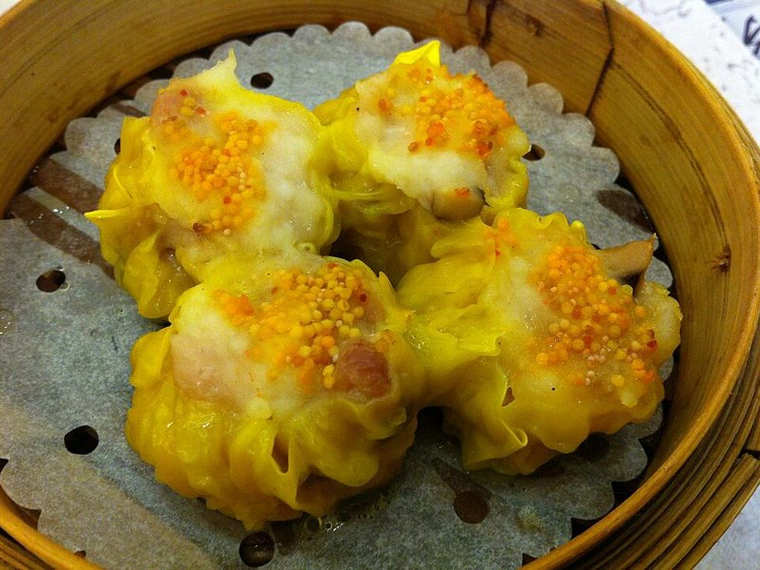
An open-topped flower of pork and shrimp.

- First record
- 1935 · Modern & global
- Fold
- Open-topped purse
- Cooked
- Steamed
Anatomy
Inside
- Wrapper
- Wheat doughYellow lye-egg skin, open top
- Filling
- Pork-shrimp-mushroom, roe
- Cooked
- Steamed
- Size
- About 4 cm across
Tastes of
- pork
- shrimp
- shiitake
Texture
- springy
- meaty
Field notes
Story
Cantonese form of the shaomai family: an open-topped yellow wrapper around pork, shrimp and mushroom, often crowned with roe or carrot. The name shaomai is first recorded in Yuan-era Beijing, in the Piao Tongshi (c. 1346); the dry-steamed Cantonese siu mai was widespread in Guangdong teahouses by the 1930s.
- How to eat it
- Eat whole from the basket; add chilli oil if you like.
- When
- Yum cha.
Did you know The same dish became Japanese shūmai, Filipino siomai and, in Melbourne, the dim sim.
Range
Where
From Guangdong.
Pin · Guangdong (pinned at Guangzhou, centre of the Cantonese teahouse tradition); no specific birthplace documented · region (first-level subdivision), not a town
- OriginGuangzhou · Lingnan · city · Cantonese
How sure we are
Evidence
Reasonably sure. Reference works agree, but we have not yet found a dated or primary source.
We list 4 sources: 2 dated texts, 2 secondary. How grading works.
First record Dry-steamed siu mai widespread in Guangdong teahouses by the 1930s (S); the shaomai name itself is attested in Yuan Dadu, Piao Tongshi c. 1346 (D)
Sources
- D
Dating of Piao Tongshi to the Yuan (scholarly study of its date of compilation).
- D
地区文化 (shaomai history; cites 朴通事, 儒林外史 ch. 10, Qianlong bamboo-branch verse, 扬州画舫录, 桐桥倚棹录)
Piao Tongshi (朴通事), Goryeo Chinese-conversation textbook set in Yuan Dadu (Beijing), lists 素酸餡稍麥 sold in the capital; base text dated to the Yuan, commonly c. 1346. The gloss 'thin wheat sheets wrapped round meat,…
Piao Tongshi (朴通事), Goryeo Chinese-conversation textbook set in Yuan Dadu (Beijing), lists 素酸餡稍麥 sold in the capital; base text dated to the Yuan, commonly c. 1346. The gloss 'thin wheat sheets wrapped round meat, steamed, eaten with soup; dialect calls it shaomai' is in the later Joseon annotated editions (Piao Tongshi eonhae, 1677), not the Yuan text. - S
Guangzhou Daily: 干蒸烧卖 among the four kings of Cantonese dim sum; Guangzhou teahouse boom of the 1920s–30s (Lu Xun visited 25 teahouses; weekly specials 星期美点 begun at Luyuju in the late 1920s).
- S
干蒸烧卖 (Baidu Baike, search snippet) and 烧卖传奇 前世今生话烧卖 (Sina, 2025-01-29)
Dry-steamed siu mai (干蒸烧卖) was popular across Guangdong by the 1930s and became a fixture of Lingnan teahouses; one of the 'four heavenly kings' of Cantonese yum cha. Late-Qing absorption of shaomai into Cantonese teahouses (undated).
Found by research and reviewed, October 2026.
Notes from the research
Cantonese form of shaomai.
The tagline and story are editorial; facts trace to the atlas research. History sources are from the atlas and not yet independently checked.
Family A