From Tibet. Popular in India (Dharamsala), global.
Pin · Central Tibet (Lhasa) · city
- OriginLhasa · Tibet (U-Tsang) · city · Tibetans
Anatomy
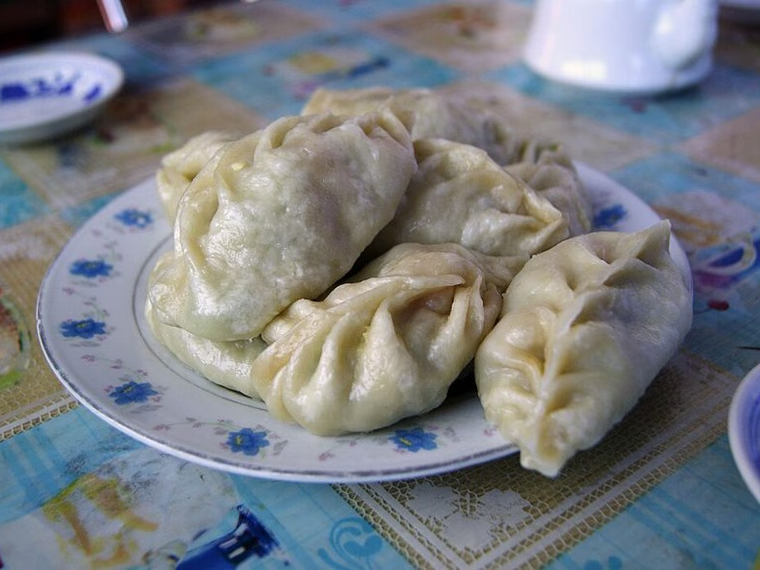
Not known yet We don’t yet have a written story or a recipe for Tibetan momo. What we do have is below, with its sources.
Range
From Tibet. Popular in India (Dharamsala), global.
Pin · Central Tibet (Lhasa) · city
How sure we are
Well established. An archaeological find or a primary source backs it.
We list 9 sources: 7 primary or archaeological, 1 secondary, 1 legend. How grading works.
First record Ramsay, Western Tibet: A Practical Dictionary, 1890: "moghmogh, a kind of small round pie filled with meat" (A); first found, recorded in Ladakh
A Tibetan-English Dictionary, with special reference to the prevailing dialects
Negative result: Jäschke 1881 has no mog-mog/mo-mo food entry (only rmo-mo, an unrelated word).
The Land of the Lamas (1891); Diary of a Journey through Mongolia and Thibet in 1891 and 1892 (1894)
NAME ONLY, NOT THE DUMPLING: in north-west China (Shanxi/Gansu/Ningxia) Rockhill records 'cakes of wheat flour called mo-kuei or mo-mo' as the people's staple (1891) and eats 'a momo' near Ningxia (1894) - the Chinese bread word 馍馍 from which Tibetan momo is usually derived.
Hand-book of Colloquial Tibetan: a practical guide to the language of Central Tibet
Food vocabulary: 'Mo-mo or mok-mo: pastry-puffs' (listed after 'Gye-khur: Chinese cakes fried in oil'). Also an example sentence: 'I am longing to eat these puffs: Nga-rang mo-mo di-ts'o sa-gyu la shem-ki-yin.'
A Tibetan-English Dictionary with Sanskrit Synonyms (entry mog-mog)
Entry: 'mog-mog (mo-mo) 1. [...] dark-coloured. 2. small meat-patty, meat-balls in a cover of paste generally cooked in steam.' No etymology given.
Journey to Lhasa and Central Tibet
Das's Journey to Lhasa (journey of 1881-82) names rgya-tug and other dishes but the OCR text has no mo-mo/mog-mog.
Ladakh: 'Meat is also minced and made into delicious little dumplings, called mok mok' (served at feasts in rich houses).
The Tibetan word 'may have been borrowed from the Chinese momo (馍馍)' (cites Eileen Guo, 'The Origins of the Barbarian Head', Eaten). No early attestations given.
Existing atlas note (general belief and legend; no dated text)
13th-century Mongol transmission and the Newar princess Bhrikuti story.
Found by research in October 2026; awaiting editorial review.
Name from Chinese 馍馍.
History sources are from the atlas and not yet independently checked.
Family B